





The Enduring Northern Hexagon
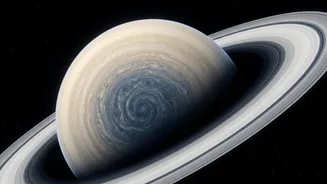
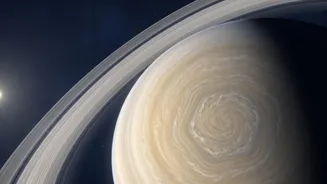
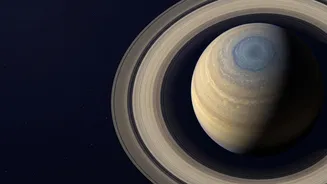
First spotted by the Voyager spacecraft in the early 1980s, Saturn's northern hexagon is a cloud pattern unlike anything else in the solar system. This six-sided jet stream is a remarkably stable and long-lasting feature, having been observed for more
than 40 years by various missions, including the Cassini spacecraft which orbited Saturn from 2004 to 2017. The structure is immense, wide enough to fit two Earths inside, and is a wave locked within a powerful jet stream near 78 degrees north latitude. Scientists have shown that this deep-rooted structure extends far down into the atmosphere, making it more than just a surface-level curiosity. While the precise mechanics are still debated, its persistence has made it one of Saturn's most defining and mysterious features, second only to its majestic rings.
A New Polygon on the Scene
For years, scientists searched for a southern counterpart to the hexagon, but found nothing. Even the Cassini probe, with its detailed 13-year survey, saw only a powerful circular vortex at the south pole, not a polygon. The story changed recently. Due to Saturn's long seasons, its south pole has tilted back toward Earth, allowing for new observations. In 2024 and 2025, amateur astronomers noticed a wavy pattern, prompting a closer look with the Hubble Space Telescope. Hubble's high-resolution images confirmed the presence of a massive, 10-sided wave—a decagon—circling the south pole. Analysis of archival data traces its faint beginnings to 2023, suggesting it is a very recent development.
A Tale of Two Poles: Key Differences
While both poles now boast a polygon, the two are far from identical. The most obvious difference is the geometry: six sides in the north versus ten in the south. This distinction points to different conditions in the jet streams that create them. Another major difference is stability. The hexagon has been a constant fixture for over four decades, whereas the decagon is a newcomer that seems to have formed only in the last few years. The southern decagon also appears less robust; its corners and sides vary in strength, and the entire pattern oscillates more than its northern cousin. Their locations also differ, with the decagon situated at a less polar latitude (around 63 degrees south) compared to the hexagon. This suggests the forces shaping them are not perfectly symmetrical across the planet.
The Science of Planetary Shapes
So, why do these shapes form at all? These polygons are not solid structures but massive atmospheric waves within powerful jet streams. On a rotating planet like Saturn, certain conditions within these fast-moving rivers of gas can cause waves to become trapped and form stable, repeating patterns. The number of sides in the resulting polygon is thought to be related to the speed and width of the jet stream. The sudden appearance of the decagon provides an unprecedented opportunity for scientists. For the first time, they can watch a large planetary weather system form in real-time. Its emergence was a surprise, as scientists have been searching for such a feature for decades without success. Why it formed now remains a key question driving current research.