


What Exactly Is Space Weather?
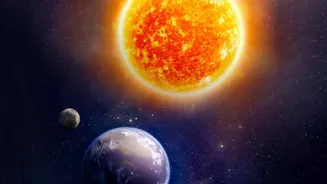
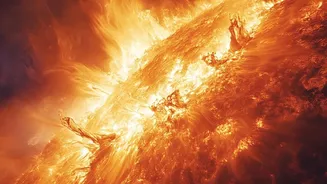
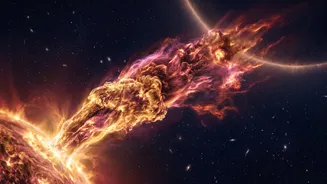
Just like Earth has weather, space has its own dynamic conditions, driven almost entirely by the Sun. Space weather refers to the changing conditions in space, primarily caused by solar activity like solar flares and coronal mass ejections (CMEs). These
events send streams of radiation and charged particles hurtling through the solar system. When this activity is directed at Earth, it interacts with our planet's magnetic field and upper atmosphere, creating what are known as geomagnetic storms. While these storms can produce beautiful auroras, they also pose a serious risk to our technology-dependent society.
The Sun's One-Two Punch: Flares and CMEs
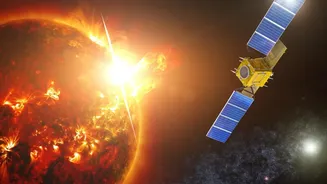
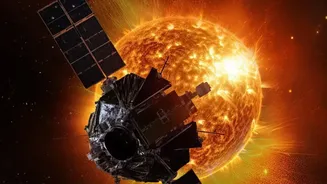
The two main culprits behind disruptive space weather are solar flares and CMEs. A solar flare is an intense, sudden burst of radiation from the Sun's surface. Think of it as the muzzle flash of a solar cannon—an enormous explosion releasing energy that can reach Earth in just minutes. This radiation can directly interfere with high-frequency radio communications and disrupt the ionosphere, an electrically charged layer of our upper atmosphere. A Coronal Mass Ejection, or CME, is a much larger event where the Sun expels a massive cloud of magnetised plasma into space. These clouds travel slower than flares, taking one to three days to reach Earth, but they carry a much more powerful punch, capable of triggering major geomagnetic storms.
The Drag Effect: Pulling Satellites Down
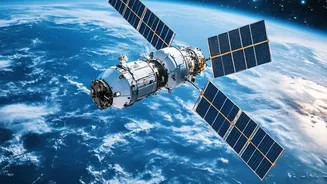
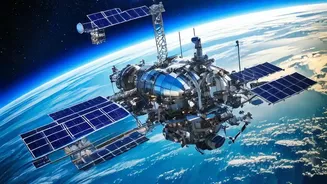
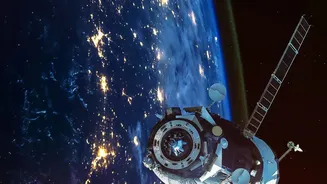
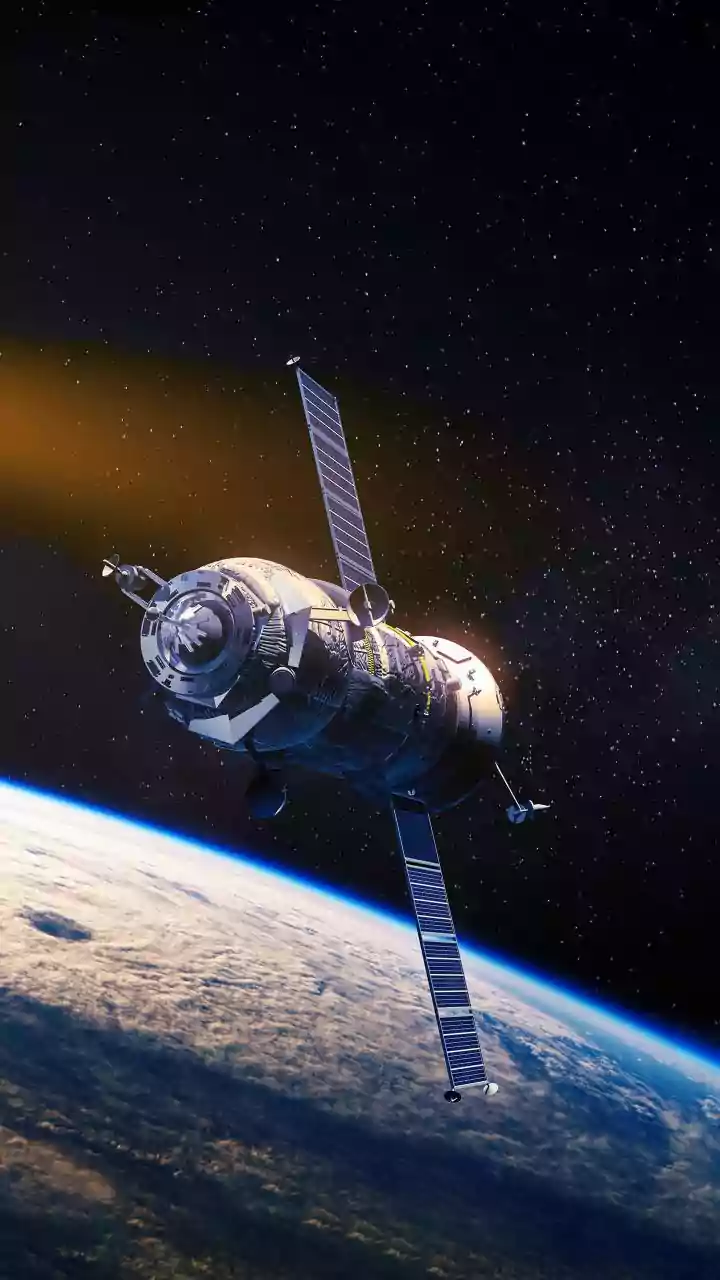
One of the most significant impacts on satellites, especially those in Low Earth Orbit (LEO), is atmospheric drag. During a geomagnetic storm, energy from the Sun heats and expands Earth's upper atmosphere, including the thermosphere where many satellites operate. This expansion increases the density of the air, creating more friction, or drag, on satellites passing through it. This increased drag slows the satellite down, causing its orbit to decay and lose altitude faster than normal. Satellite operators must then use precious fuel to boost the satellite back into its correct orbit. During intense solar activity, these manoeuvres may be needed every few weeks instead of a few times a year. In a dramatic 2022 incident, a geomagnetic storm caused increased drag that led to the loss of up to 40 newly launched Starlink satellites.
Electronic Havoc and Radiation Damage
Beyond the physical drag, space weather can wreak electronic havoc. High-energy particles from solar events can bombard a satellite, causing a range of problems. This can lead to 'spacecraft charging,' where an electrical charge builds up on the satellite's surface, potentially causing electrostatic discharges—essentially a short circuit in space that can damage sensitive components. Furthermore, high-energy particles can penetrate satellite shielding and directly strike microelectronics, causing 'single-event upsets.' These can corrupt data, cause a processor to reset, or even lead to permanent damage. Over time, the cumulative radiation exposure, known as the total ionizing dose, degrades solar panels and other electronic components, ultimately shortening a satellite's operational lifespan.
Losing Our Way: The Impact on GPS
The same space weather that affects satellites also messes with the signals they send, particularly for Global Navigation Satellite Systems (GNSS) like GPS. GPS works by calculating your position based on signals from multiple satellites. These signals must travel through the ionosphere to reach your receiver on the ground. During a geomagnetic storm, the ionosphere becomes disturbed and irregular. This can bend, delay, or scatter the GPS signal, a phenomenon known as 'scintillation.' Your GPS receiver, which expects a clear and timely signal, can no longer calculate an accurate position. Errors that are normally just a few meters can swell to tens of meters, and in severe cases, the receiver can lose its lock on the satellites altogether. This can disrupt everything from precision agriculture and aviation to simple turn-by-turn directions in your car.