





Look up soon. The skies over India are set to host a remarkable visitor: SpaceX's Starship, the most powerful rocket ever built. Its upcoming test flight will carve a path across the country, marking a new chapter in the story of global space travel.
The World's Most Powerful Rocket
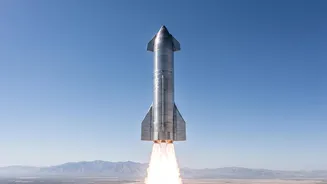
Before we talk about its journey over India, it's worth understanding what Starship is. Developed by Elon Musk's SpaceX, Starship is a two-stage, super heavy-lift launch vehicle designed to be fully and rapidly reusable. Standing taller than any rocket in history, its primary goal is to carry crew and cargo to Earth orbit, the Moon, Mars, and potentially beyond. The entire system is comprised of the Super Heavy booster and the Starship spacecraft itself. What makes it revolutionary is the goal of complete reusability for both stages, a feat never before achieved in orbital rocketry. By catching and relaunching both the booster and the spacecraft, SpaceX aims to drastically lower the cost of access to space, making ambitious projects like a Moon base or a city on Mars economically feasible. This isn't just another rocket; it's a vehicle designed to fundamentally change humanity's relationship with space.
A Trail Across the Indian Sky
The upcoming mission, designated Starship Flight 15, has a flight plan that is particularly exciting for observers in India. Targeted for launch as early as November 14 (IST) from Starbase, Texas, the spacecraft is slated to spend over 22 hours in orbit. During this time, it will complete approximately 14 orbits around the Earth before attempting its return. This extended time in space means Starship will pass over parts of India multiple times during the mission. While some previous test flights had splashdown zones in the Indian Ocean, this flight's orbital path presents a unique opportunity. The trajectory demonstrates growing confidence in the vehicle's reliability and is a crucial step in testing versatile launch capabilities, including polar orbits needed for certain satellite deployments.
Why This Pass Is So Notable
A key objective of Flight 15 is to deploy 26 Starlink V3 internet satellites into orbit. This mission also aims for a history-making first: catching both the Super Heavy booster and the Starship upper stage back at the launch tower using giant mechanical arms nicknamed 'chopsticks'. A successful double-catch would be a monumental milestone, proving the system's full reusability. The pass over India is notable not just as a geographical fact, but as a symbol of this new operational phase. Previous test flights focused on suborbital paths over unpopulated ocean areas to ensure public safety during the learning process. An orbital flight that crosses major landmasses like India signifies a shift from pure development to operational deployment, showcasing the rocket's global reach and the trust placed in its systems.
What to Expect on the Ground
For skywatchers in India, the key question is: will it be visible? The answer is complex. Starship is expected to orbit at an altitude of roughly 275 kilometres. At that height, it will not be visible to the naked eye during the day. However, there might be opportunities to spot it. The best chance for visibility occurs when the sky on the ground is dark, but the spacecraft is still illuminated by the sun at its high altitude. This typically happens shortly before sunrise or after sunset. If conditions are right, observers might see a faint, fast-moving point of light silently streaking across the sky. While not a dramatic spectacle like a low-flying plane, spotting the world's largest spacecraft on its historic journey would be a memorable event for any space enthusiast. Realtime tracking data and flight visualisations are often made available online by spacetracking communities, which can help pinpoint when and where to look.