



Why Venus? Earth's Hellish Twin
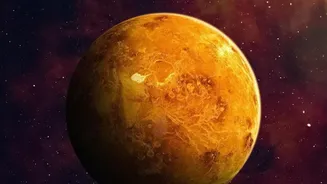
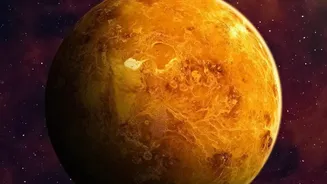
Venus is often called Earth's twin due to its similar size, mass, and density. However, the similarities end there. It is the hottest planet in our solar system, with a surface temperature that can melt lead and a crushing atmospheric pressure over 90
times that of Earth's. The planet is perpetually shrouded in dense clouds of corrosive sulfuric acid, making its surface impossible to see with conventional telescopes. Scientists are fascinated by this dramatic divergence; understanding why Venus became a runaway greenhouse inferno could offer crucial insights into Earth's own climate dynamics and long-term future. Shukrayaan aims to find answers to this very question.
A Mission of Firsts for India
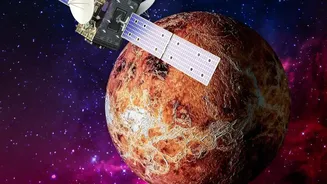
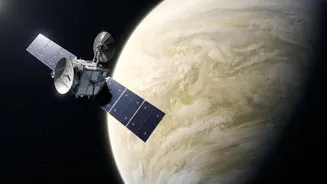
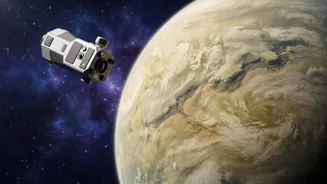
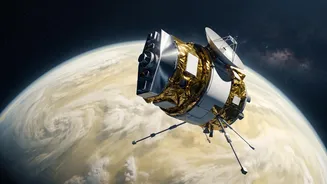
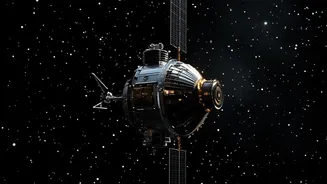
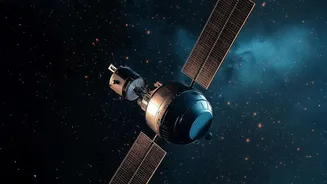
Shukrayaan, which means "Venus Craft" in Sanskrit, is India's first dedicated mission to the planet and its second interplanetary venture after the highly successful Mangalyaan Mars mission. Following formal approval from the Union Cabinet in September 2024, the mission is now on track for a planned launch on March 29, 2028, aboard ISRO's powerful LVM-3 rocket. After a 112-day journey, the spacecraft is expected to enter a unique elliptical orbit around Venus, allowing its instruments to gather data from various altitudes, from as close as 500 km to as far as 60,000 km. This ambitious project, with a budget of approximately ₹1,236 crore, not only enhances India's space exploration portfolio but also showcases its capability for cost-effective deep-space missions.
Peering Through the Clouds
The mission's primary challenge and its greatest opportunity lie in penetrating the opaque Venusian atmosphere. To do this, Shukrayaan will be equipped with a suite of sophisticated instruments, many of them developed in India. The headline instrument is a high-resolution Synthetic Aperture Radar (SAR), a powerful tool capable of piercing through the thick clouds to map the planet's surface in unprecedented detail. This will allow scientists to study geological features like volcanic hotspots, lava flows, and mountains, searching for evidence of current volcanic or tectonic activity. Another key instrument is a ground-penetrating radar, designed to investigate the shallow subsurface structure—a feat no previous mission has accomplished.
An Indigenous Toolkit for Discovery
Beyond surface mapping, a major focus is the atmosphere itself. Indian-developed sensors will analyze the composition, structure, and dynamics of the toxic air. These instruments will study the super-rotating winds that whip around the planet and investigate the complex chemistry of the sulfuric acid clouds. The orbiter will also carry payloads to study the interaction between the solar wind—a constant stream of charged particles from the Sun—and the Venusian ionosphere. Understanding this process is key to figuring out how Venus lost its water and evolved so differently from Earth. The mission will carry around 19 scientific payloads in total, including collaborations with international partners like Sweden, Russia, and Germany, making it a truly global scientific effort led by India.
India's Place in a New Space Race
Interest in Venus has been reignited globally, with NASA and the European Space Agency (ESA) also planning their own missions. Shukrayaan is poised to arrive slightly ahead of NASA's VERITAS and ESA's EnVision orbiters, positioning India as a key contributor to this new era of Venus exploration. The data collected by these independent missions will be complementary, providing a comprehensive, multi-faceted view of the planet never before possible. For India, the mission is more than a scientific endeavour; it's a statement. Success would cement ISRO's reputation as a world-class space agency capable of leading complex interplanetary science, following its historic achievements on the Moon and Mars.