






The Simple Physics of a Slippery Road
The core issue is a dramatic reduction in friction. When roads are dry, your running shoes and a car's tyres have a direct, grippy connection to the asphalt. Rain introduces a thin, often invisible layer of water that sits between those surfaces. This
film of water prevents the tread from making solid contact, a phenomenon known as hydroplaning, which can happen on a micro-level for shoes and a larger scale for tyres. As a result, the grip needed to slow down or stop is significantly compromised. For vehicles, braking distance on wet roads can easily double or even triple compared to dry conditions. When rain first begins, it can mix with oil and grime on the road, making the surface even more slick than during a sustained downpour.
For the Runner: Adjusting Your Stride
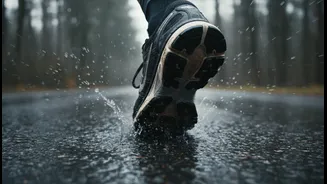
For a runner, less friction means that sudden stops or sharp turns become high-risk manoeuvres. Your shoe's outsole, designed with grooves to channel water away, can be overwhelmed, leading to a slip. The key to staying upright is to adapt your running form. Experts recommend shortening your stride and increasing your cadence (the number of steps you take per minute). This keeps your feet landing more directly underneath your center of gravity, reducing the 'braking' force of a long stride where your heel lands far in front of your body. Think about landing with a flatter foot rather than an aggressive heel-strike. Be especially cautious on painted road markings, manhole covers, and piles of wet leaves, which are notoriously slippery.
For the Support Vehicle: Doubling Your Distance
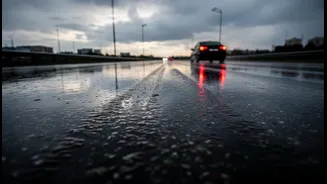
If you are driving a support vehicle for a runner, the responsibility for safety is magnified in the rain. Standard following distances are completely inadequate. The widely-cited 'two-second rule' for dry weather should be doubled to at least four seconds in the wet. Some safety experts even suggest a five- or six-second gap to provide a sufficient buffer. This extra space is critical because it can take about three times longer to brake on wet roads. A driver must anticipate the runner's movements far in advance. A runner might stop suddenly or swerve to avoid a puddle, and the vehicle needs ample time and distance to react without slamming on the brakes, which itself can cause a skid. Slowing your overall speed by about a third is another recommended tactic to regain control.
Essential Gear and Visibility
Wet weather dramatically reduces visibility for everyone. A support vehicle should always have its headlights on, even during the day, to be more visible to other cars and the runner. For the runner, bright and reflective clothing is non-negotiable. A hat with a brim is also a practical piece of gear, helping to keep rain out of your eyes so you can better see the path ahead. When it comes to footwear, shoes with good tread are vital to help channel water and maintain grip. While trail shoes might seem like a good idea, their deep lugs can sometimes be less effective on flat, wet pavement compared to road shoes with softer rubber compounds and well-designed tread patterns.
Communication and Planning Are Crucial
In adverse conditions, unspoken assumptions can lead to disaster. Before the run begins, the runner and driver should agree on a plan. Discuss the route, potential hazards, and establish clear hand signals for stopping, slowing down, or pointing out dangers. The runner should never assume the driver has seen them or can stop on a dime. The driver, in turn, must remain hyper-vigilant, scanning the road far ahead and anticipating the runner's needs. Because visibility and reaction times are compromised for both parties, removing distractions is essential. This means the runner should consider leaving headphones at home, and the driver must put away their phone and focus completely on the task of safely shadowing their runner.