
Welcome to the 'Hot Jupiters'
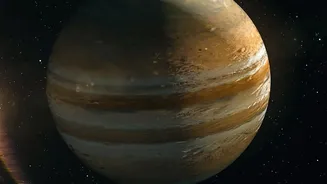
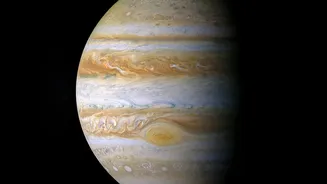
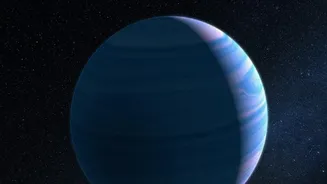
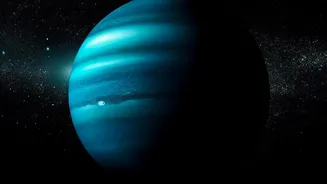
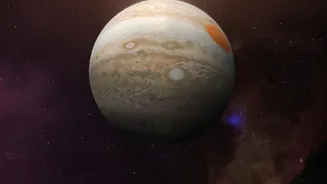
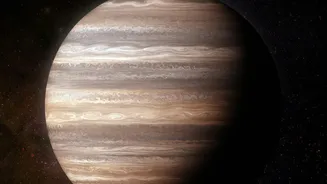
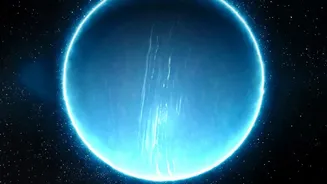
The stars of these wild weather reports are a class of exoplanets known as 'hot Jupiters'. These are gas giants similar in size to our own Jupiter, but they orbit incredibly close to their parent stars, often completing a full year in just a few Earth
days. This extreme proximity means they are tidally locked, with one side perpetually facing the star's blistering heat and the other in permanent darkness. The day side can reach temperatures exceeding 2,400 degrees Celsius, hot enough to vaporise metals like iron. It's this enormous temperature difference between the day and night sides that creates the perfect conditions for some of the most extreme weather in the known universe.
Winds Faster Than a Speeding Jet
The massive temperature gradient on these planets drives ferocious winds that make Earth's hurricanes look like a gentle breeze. On a planet named HAT-P-70 b, astronomers measured wind speeds of up to 18,000 kilometres per hour. On another, WASP-76b, winds carrying vaporised iron are estimated to blow at around 18,000 km/h. These aren't just strong winds; they are often supersonic, moving faster than the speed of sound through the planet's own atmosphere. This superheated air rushes from the scorching day side to the cooler night side, carrying with it whatever elements have been turned into gas by the intense stellar radiation. This constant, violent circulation of the atmosphere is a key reason for the bizarre precipitation seen on these worlds.
An Evening Forecast of Iron Rain
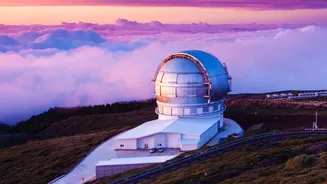
On the day side of exoplanet WASP-76b, located about 640 light-years away, it's so hot that iron doesn't just melt; it evaporates into a metallic gas. These clouds of gaseous iron are then swept toward the night side by the planet's powerful winds. As the iron vapour reaches the cooler night side—where temperatures drop to a still-fiery 1,500 degrees Celsius—it condenses back into a liquid. The result is a truly alien phenomenon: rain made of molten iron. Astronomers using instruments like the ESPRESSO spectrograph on the Very Large Telescope were able to confirm this by detecting a strong signature of iron vapour at the 'evening' boundary of the planet, but not at the 'morning' boundary, suggesting the iron had rained out during the night.
Seeing the Unseen with Infrared Light
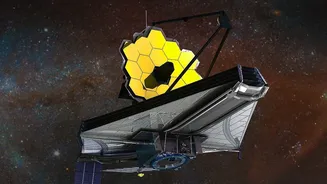
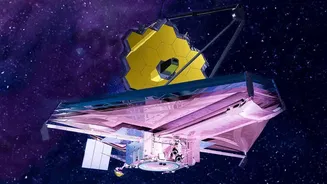
So how do we know all this is happening on planets hundreds of light-years away? The key is infrared astronomy. Telescopes like the James Webb Space Telescope (JWST) and the Spitzer Space Telescope are designed to detect infrared light, which we perceive as heat. By measuring the infrared light from an exoplanet as it orbits its star, astronomers can create temperature maps of its surface and atmosphere. Furthermore, by analysing the spectrum of starlight that filters through a planet's atmosphere—a technique called transit spectroscopy—scientists can identify the chemical elements present, such as water, carbon dioxide, and even vaporised metals like iron. These powerful tools allow us to move beyond simply detecting exoplanets to actually characterising their climates.
What This Wild Weather Tells Us
Studying these extreme climates does more than just satisfy our curiosity about alien worlds. It provides a natural laboratory for testing our understanding of physics and chemistry under conditions that don't exist in our solar system. The varied compositions of these gas giants challenge our models of how planets form. For example, recent findings about wind patterns on some hot Jupiters have provided the first evidence of magnetic fields on planets outside our solar system. These magnetic fields are crucial for protecting a planet's atmosphere from being stripped away by its star, a key factor in the search for potentially habitable worlds in the future. Each new discovery, no matter how bizarre, adds another piece to the puzzle of how planets—including our own—come to be.