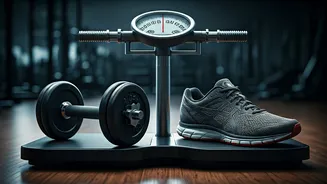









The Decision: Embrace Progressive Overload
The single most transformative decision you can make for your gym results is to commit to the principle of progressive overload. In simple terms, this means you must gradually increase the demands you place on your body over time. Your muscles won't grow
stronger or larger unless they are challenged beyond their current capacity. Many gym-goers fall into the trap of doing the same workouts with the same weights and reps for months, wondering why their progress has stopped. Your body is incredibly adaptable; once it gets used to a certain level of stress, it has no reason to change. The decision to actively and systematically make your workouts more challenging over time is the key to breaking through plateaus.
How It Works: The Science of Adaptation
When you lift weights or perform resistance exercise, you create tiny micro-tears in your muscle fibers. In response, your body doesn't just repair this damage, it overcompensates by rebuilding the fibers stronger and thicker to better handle that stress in the future. This process is called hypertrophy. Progressive overload is the method of continuously triggering this adaptive response. Without a gradual increase in challenge, the stimulus isn't great enough to signal the need for further adaptation. By consistently asking your muscles to do a little more than they're used to, you provide the necessary impetus for continuous growth and strength gains.
Putting It Into Practice: Four Key Methods
Applying progressive overload doesn't always mean lifting heavier, although that is the most common method. Here are four practical ways to implement it: 1. Increase Resistance: This is the most straightforward approach. Once you can comfortably complete your target number of repetitions with good form, it's time to increase the weight slightly. Even a small jump of 2.5% to 10% is enough to create a new challenge. 2. Increase Repetitions (Reps): Using the same weight, focus on completing more reps per set. For example, if your goal is 8-12 reps and you can only do 8, work towards hitting 12 with good form before increasing the weight. 3. Increase Volume (Sets): Another way to increase demand is to add another set to your exercises. If you typically do three sets of squats, try doing four in your next session to increase the total workload on your muscles. 4. Decrease Rest Time: By reducing the rest periods between your sets, you increase the overall intensity and density of your workout, forcing your body to adapt to recovering more quickly under stress.
The Tool You Can't Ignore: Tracking Your Progress
Progressive overload is impossible to apply effectively if you are training blind. The decision to implement it goes hand-in-hand with the decision to track your workouts. You can’t know if you’re progressing if you don’t remember what you lifted last week. Using a simple notebook or a fitness app to log your exercises, weights, reps, and sets is crucial. This log becomes your roadmap; it provides objective data that tells you exactly what you need to do in your next session to ensure you are progressing. Looking back at your log and seeing your numbers climb is also a powerful motivational tool that proves your hard work is paying off.
Avoiding Common Pitfalls
As you apply progressive overload, it's vital to prioritize proper form to avoid injury. The goal is to get stronger, not to lift the heaviest weight with poor technique, often called 'ego lifting'. If you have to compromise your form to lift a heavier weight, it’s too heavy. Progress should be gradual. Don't try to increase weight, reps, and sets all at once. Pick one variable and focus on improving it over a few sessions before making another change. Lastly, listen to your body. Overtraining can lead to burnout and injury, so ensure you are getting adequate rest, sleep, and nutrition to support your recovery and muscle growth.