




The Persistent Challenge of Grey Skies
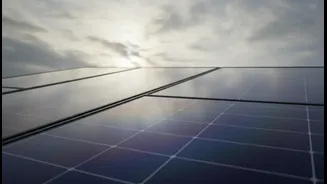
India has made massive strides in solar energy, harnessing its abundant sunshine to power homes and industries. However, a significant hurdle remains: the weather. The performance of conventional solar panels drops dramatically on overcast days and during
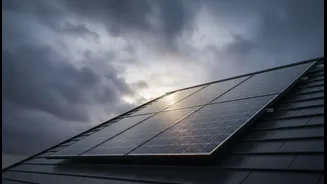
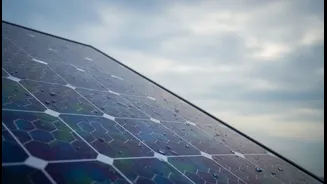
the long monsoon season, which can affect large parts of the country for months. This intermittency is a major challenge for a stable energy grid. Traditional photovoltaic (PV) cells convert direct sunlight into electricity, but their efficiency plummets when clouds scatter that light. On heavily overcast days, a panel's output can fall to just 10-25% of its capacity, making solar power a less reliable source when consistent energy is needed most. This has historically limited solar energy's role to that of a 'fair-weather' solution.
A New Generation of Solar Technology
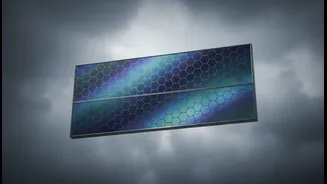
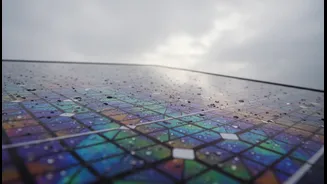
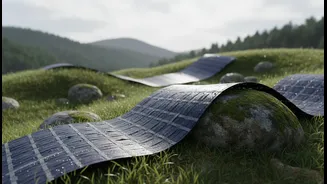
The good news is that researchers are tackling this problem head-on with several promising innovations. One of the most exciting fields involves materials called perovskites. Perovskite solar cells (PSCs) have shown remarkable potential because their properties can be 'tuned' to absorb light more efficiently under low-light conditions. Unlike traditional silicon panels, which are optimised for bright, direct sun, some new perovskite designs have achieved incredibly high efficiency rates of over 40% in indoor or simulated low-light environments. This superior performance in capturing diffuse light—the kind that dominates on a cloudy day—is at the heart of this technological leap.
From Cloudy Days to Rainy Nights
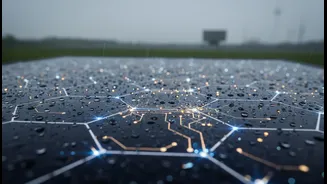
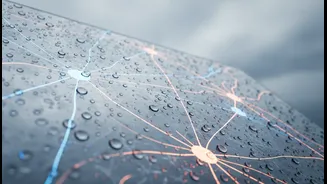
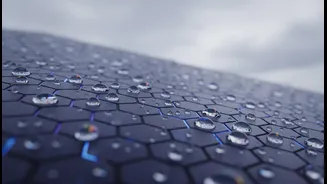
Researchers are even pushing the boundaries beyond just low light. Some scientists are developing hybrid 'all-weather' panels that can generate electricity from the impact of raindrops. These experimental panels incorporate a transparent layer called a triboelectric nanogenerator (TENG). When a raindrop hits the surface and rolls off, the friction creates a small static charge that the TENG can harvest and convert into usable electricity. One design from researchers in China and Spain uses a thin film that protects the underlying perovskite cell while also acting as the energy-harvesting layer for raindrops. While still in development, this technology could one day mean that solar installations continue producing power not just on cloudy days, but even during a nighttime rainstorm.
What This Means for India's Energy Future
The implications for India are enormous. A solar panel that performs reliably during the monsoon season would be a true game-changer. It would dramatically increase the viability of solar power in regions with heavy rainfall and cloud cover, like the coastal states and the northeast. This would help stabilise the energy grid, reduce dependence on fossil fuels year-round, and accelerate the country's transition to clean energy. Furthermore, technologies that improve low-light performance, such as TOPCon and HJT cells, are already entering the market, promising incremental gains in energy yield during mornings, evenings, and overcast days. While the government has supported domestic manufacturing through schemes like the Production Linked Incentive (PLI), the focus has been on scaling up existing technologies. These new breakthroughs could shape the next generation of manufacturing.
The Road to Your Rooftop
While these developments are exciting, it is important to maintain a realistic timeline. Many of these advanced technologies are still in the research and development phase. Perovskite cells, for example, have faced challenges with durability and degradation when exposed to the elements over long periods, though protective coatings are improving their stability. The cost of these new materials and manufacturing processes also needs to come down to compete with the established silicon panel industry. Researchers estimate that commercial prototypes of some all-weather panels could be ready within a few years, but mass-market adoption will take longer. For now, the focus is on scaling up production, improving longevity, and proving that these lab-based successes can be replicated in real-world conditions reliably and affordably.