

The Giants at the Galactic Center
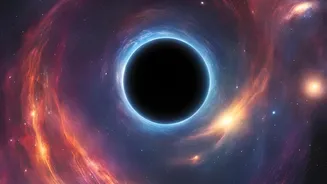
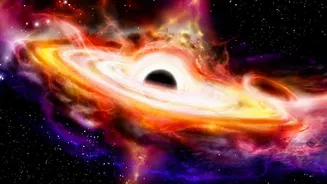
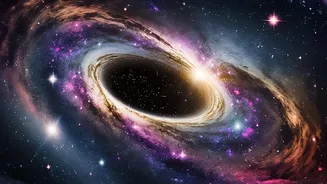
Supermassive black holes are the gravitational anchors of galaxies. While the black holes themselves are invisible, the regions around them, known as Active Galactic Nuclei (AGN), can be staggeringly bright. As immense quantities of gas, dust, and even
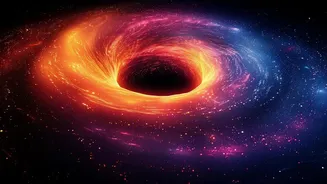
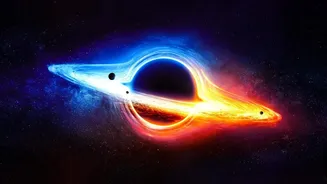
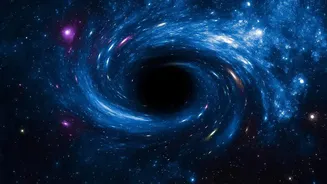
whole stars are pulled inward by gravity, they form a swirling structure called an accretion disk. The friction within this disk heats the material to extreme temperatures, causing it to glow so intensely that it can outshine all the stars in its host galaxy combined. It is this luminous, turbulent region that astronomers study to understand the behaviour of the black hole itself.
A Stormy Cosmic Forecast
For a long time, scientists believed the processes powering these bright galactic centers unfolded over vast, geological timescales. But years of dedicated observation are showing something different. The 'environment' near a black hole isn't just the accretion disk, but also a mysterious, billion-degree cloud of plasma called the corona. This superheated corona is a source of powerful X-rays, and recent studies show it is far from static. Research has revealed that the corona can shift its position dramatically, gathering inward before being launched away from the black hole. This movement causes sudden, intense flares of X-ray light, acting like a form of 'cosmic weather' that is surprisingly quick and violent.
What 'Rapid' Means in Space
When astronomers say 'rapid', they are speaking in cosmic terms, but the timescales are still mind-bogglingly short compared to the life of a galaxy. Instead of changes occurring over millions of years, events like powerful X-ray flares can erupt and fade in less than 60 days. Other phenomena, like the launching of powerful jets of material, were once thought to be constant. Now, research covering over 20 different events shows that these jets can switch on and off. One study found that black holes, regardless of their size, seem to launch these jets only when their feeding rate drops to a specific threshold. This suggests a universal 'rule' for black holes from 10 times the sun's mass to millions of times, linking their eating habits directly to these dramatic environmental shifts.
Rewriting the Rules of Galaxy Growth
These rapid shifts have profound implications for how galaxies evolve. The energy and material blasted out from the vicinity of a supermassive black hole—a process called 'feedback'—don't just stay local. These outflows and jets can carry immense energy into the host galaxy, and new studies suggest they may even influence star formation in neighbouring galaxies millions of light-years away. Rather than simply preventing star birth by blowing away gas, some findings indicate that the feedback from an active black hole can compress surrounding gas, triggering the formation of new stars in rings and arcs. This discovery paints a more complex picture of a feedback cycle, where black holes are not just cosmic destroyers, but active sculptors of their galactic ecosystems.