







The Annual Solar Slowdown
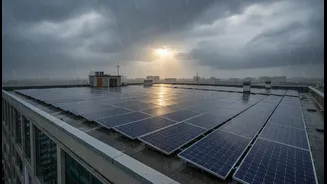
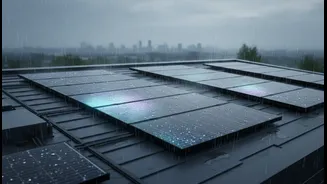
India has made massive strides in solar energy, becoming a global leader in deployment. Yet, for several months each year, the nation's solar output faces a predictable hurdle: the monsoon. Traditional solar panels, made primarily of silicon, are at their
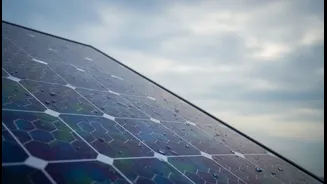
best under bright, direct sunlight. When thick clouds roll in, their electricity generation can drop significantly. While they don't stop working entirely, and still generate power from diffused light, the reduction can be substantial, often falling to a fraction of their peak capacity. This seasonal variability creates a major challenge for grid stability and complicates the country's transition to consistent, year-round renewable energy. The dip in production is a known variable, but one that energy planners have had to work around, often relying on other power sources to fill the gap left by underperforming solar farms during the rainy season.
Thinking Beyond Silicon
For decades, silicon has been the undisputed king of the solar world. It is reliable, relatively efficient, and its manufacturing process is mature. However, its performance in low-light conditions is a known limitation. Silicon has a fixed 'bandgap', which dictates the specific wavelengths of light it can convert into electricity most efficiently. While perfect for bright sunshine, it's less effective at capturing the scattered, diffuse light that dominates on an overcast day. This is where the search for alternative materials comes in. Researchers have been exploring new classes of materials that are not only cheaper and more flexible to produce but also have properties better suited for variable weather. The goal is to create solar cells that are more sensitive to the broader spectrum of light available when the sun isn't shining brightly.
Meet the New Contenders: Perovskites and Organics
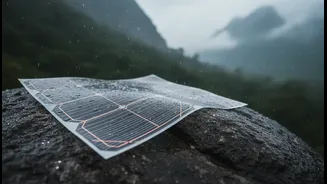
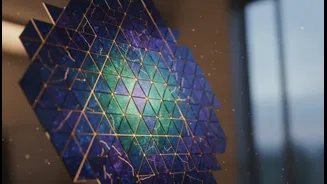
Two of the most promising families of materials are perovskites and organic photovoltaics (OPV). Unlike rigid silicon panels, these can be formulated as inks and printed onto flexible surfaces. Perovskites are a class of materials with a specific crystal structure that is exceptionally good at absorbing light. Their key advantage is a 'tunable bandgap', meaning scientists can adjust their chemical composition to make them more efficient at absorbing different kinds of light, including the ambient light found indoors or on cloudy days. Organic photovoltaics, as the name suggests, use carbon-based molecules to capture light. These materials are lightweight, can be made semi-transparent, and are highly effective in low-light environments, making them ideal for a range of applications beyond traditional panels.
How They Conquer the Clouds
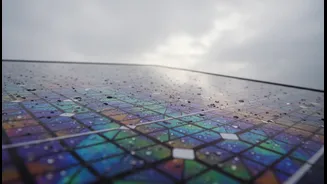
The secret to the superior low-light performance of these new materials lies in their ability to absorb a wider range of the light spectrum. On an overcast day, the light that reaches the ground is more diffuse and has a different spectral composition than direct sunlight. Perovskite and organic cells can be engineered to be more sensitive to these conditions. They are better at converting ambient and indirect light into electrical current, maintaining a more stable output even as cloud cover thickens. Recent research has demonstrated remarkable efficiencies for these materials under indoor and low-light simulations, far surpassing what silicon can achieve in the same environment. This means that while a silicon panel's output might plummet, a next-generation panel could continue generating a more significant and useful amount of power.
The Road from Lab to Rooftop
Despite the immense promise, you won't be seeing these panels on every rooftop just yet. The biggest challenge for perovskite solar cells has been durability. Early versions tended to degrade when exposed to humidity and heat—precisely the conditions of an Indian monsoon. However, significant progress is being made to improve their stability, with new formulations lasting much longer in real-world tests. For both perovskites and organic cells, the next step is scaling up production from laboratory-sized cells to large, commercial-grade panels while keeping costs down. Researchers are actively working with industry partners to solve these engineering challenges. While widespread commercial deployment is still some years away, the path is becoming clearer for these materials to supplement, and perhaps one day compete with, silicon.