





A Journey's Second Act
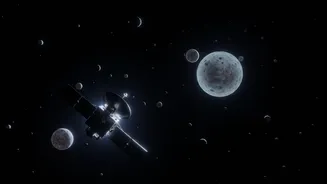
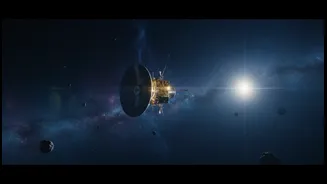
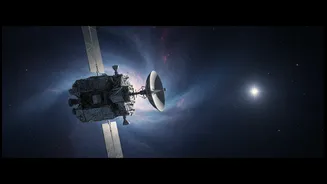
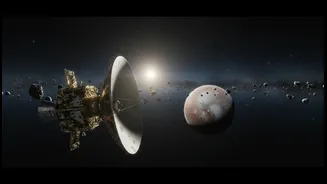
After its historic flyby of Pluto, which revealed a surprisingly dynamic world with ice mountains and a vast nitrogen glacier, New Horizons did not power down. Instead, NASA extended its mission, sending it deeper into the Kuiper Belt, a vast, donut-shaped
ring of icy bodies circling the outer solar system beyond Neptune. This second act transformed the probe from a planetary visitor into a deep-space observatory, venturing into a region that had never been explored up close. The goal was to study the primordial building blocks of our solar system, objects preserved in a deep freeze for billions of years. This extended mission highlights a crucial aspect of space exploration: the immense scientific value that can be extracted from a spacecraft long after it has achieved its primary objective.
Encounter with Arrokoth
On New Year's Day 2019, New Horizons made history again when it flew past Arrokoth, the most distant object ever explored by a spacecraft. Located a billion and a half kilometres beyond Pluto, Arrokoth is a contact binary, essentially two smaller objects that gently merged to form a snowman-like shape. The discovery was profound. Its reddish surface is covered in organic compounds called tholins, and its largely uncratered appearance suggests it has remained mostly unchanged since the dawn of the solar system. The gentle way its two lobes came together supports theories that planets formed from the slow, gravitational collapse of particle clouds rather than violent collisions. In studying Arrokoth, scientists were effectively looking at a 4.5-billion-year-old time capsule.
A New Kind of Science
Now billions of kilometres from Earth, New Horizons has a new purpose. It serves as a unique platform for heliophysics, studying the outer reaches of the heliosphere—the vast bubble of charged particles and magnetic fields blown outward by our Sun. Its instruments measure the solar wind and dust environment in a region no other active mission is currently exploring. Recently, in July 2026, the spacecraft woke up from a 321-day hibernation period in good health to continue its work. It is currently travelling away from us at a rate of nearly 500 million kilometres per year, providing a unique vantage point that helps scientists understand the boundary where the Sun's influence ends and interstellar space begins.
The Wisdom of Ageing Explorers
New Horizons is not alone in its longevity. It follows in the footsteps of NASA’s iconic Voyager 1 and 2 probes, launched in 1977. These spacecraft, originally designed for a five-year mission to Jupiter and Saturn, have been operating for nearly five decades and are now sending back data from interstellar space. The value of these ageing explorers is immense. They provide a long-term record of conditions in the outer solar system, data that simply cannot be replicated by new, short-term missions. They show us how the solar environment changes over decades and give us our only direct measurements of the space between stars.
The Challenges of Deep Space
Keeping these missions alive is a monumental feat of engineering. With New Horizons, radio signals take nearly nine hours to travel one way, making real-time control impossible. For the even more distant Voyagers, that delay is over 22 hours. Engineers must contend with dwindling power from decaying plutonium sources, forcing them to make difficult decisions about which instruments to shut down to conserve energy. Furthermore, the original engineers are often retired or have passed away, meaning new generations of operators must rely on decades-old documents to troubleshoot problems on 1970s-era computers with less memory than a modern car key fob. Each software patch or command sequence is a high-stakes effort to keep these invaluable missions talking to us.