







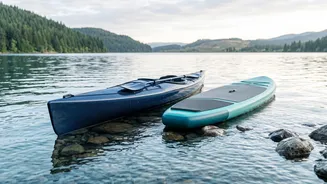
The First Hurdle: The Learning Curve
For most beginners, a kayak offers a feeling of immediate security. You sit low in the water, which creates a stable center of gravity, making sit-on-top kayaks feel almost tip-proof. The learning curve is gentle; within minutes, most people can paddle
in a straight line. A stand-up paddleboard, on the other hand, requires balance. While modern rental boards are wide and surprisingly stable, it takes time to get comfortable standing. Many beginners start on their knees and progress to standing as their confidence grows. If you fall off a paddleboard, getting back on is relatively easy, whereas re-entering a kayak from the water can be more challenging.
What to Expect: The Rental Package
When you rent either a kayak or a paddleboard, the essentials are almost always included. A standard kayak rental package includes the kayak itself, a double-bladed paddle, and a personal flotation device (PFD), or life jacket. Similarly, a paddleboard rental will provide you with the board, a single-bladed paddle, a PFD, and a safety leash that connects you to the board. Most rental shops that cater to beginners also provide a brief safety orientation and basic instructions before you launch. Items not typically included are water, sunscreen, towels, or waterproof bags for your phone and keys, although some locations may offer dry bags for an extra fee or as part of the package.
The Price of Adventure: Comparing Costs
Rental costs for kayaks and paddleboards are generally very similar, making it unlikely that price will be the deciding factor. Hourly rates often range from $15 to $30, while full-day rentals can be anywhere from $50 to $100. In some locations, a single kayak might be slightly cheaper per hour than a paddleboard, while in others, the prices are identical. Tandem (two-person) kayaks are also widely available and cost more than single kayaks but can be a cost-effective option for a pair. Ultimately, the price depends more on the location and rental duration than on your choice of watercraft.
The On-Water Experience: Vibe and View
The experience each craft offers is distinctly different. Kayaking puts you low to the water, offering a comfortable, seated position that's ideal for longer paddles or exploring in windy conditions. You get a unique, water-level view of your surroundings. A paddleboard provides a completely different perspective. Standing up gives you an excellent vantage point for looking down into the water to see fish or submerged features. It also offers more freedom of movement—you can stand, kneel, sit, or even lie down. A SUP feels more like a playful, open platform, making it great for socializing and jumping in for a swim.
Fitness and Fun: Which Is a Better Workout?
Both activities are excellent forms of exercise, but they engage your body differently. Kayaking is primarily an upper-body and core workout. A proper paddling technique involves rotating your torso, which heavily engages your back, shoulders, and abdominal muscles. Stand-up paddleboarding provides a more comprehensive, full-body workout. Simply balancing on the board continuously engages your leg and core muscles. Every paddle stroke then adds an upper-body and rotational core element, making it a low-impact activity that works everything from your feet to your shoulders.