




A Salty Surprise Around Jupiter
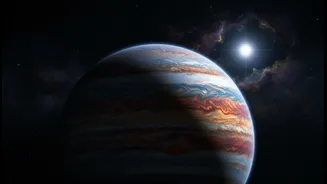
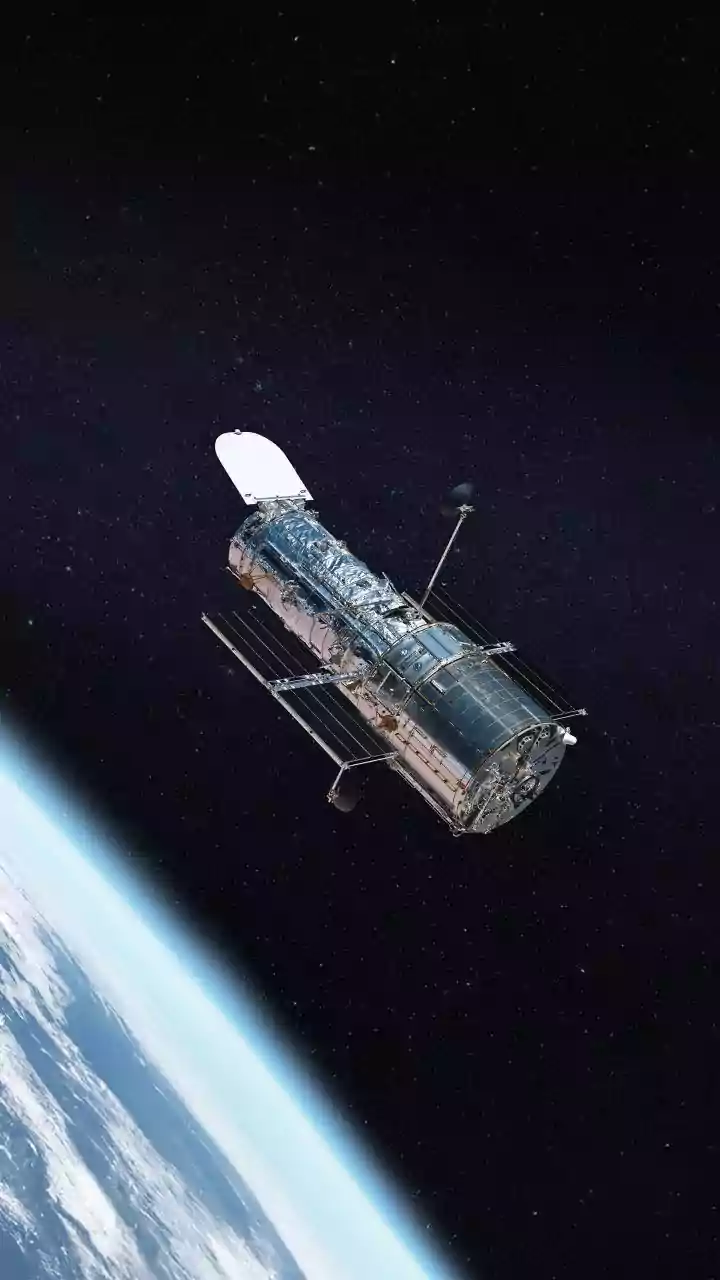
When you think of salt, you likely picture Earth’s oceans or your kitchen table. Scientists, however, are now finding it in one of the last places you'd expect: on the surface of Jupiter’s icy moon, Europa. Using powerful instruments like the Hubble Space
Telescope, researchers have detected the chemical signature of sodium chloride—common table salt—staining parts of Europa's frozen crust. The most intriguing part is where this salt is found. It's concentrated in geologically young and chaotic terrains, suggesting it’s not from an external source but has bubbled up from within. This discovery implies that Europa's vast subsurface ocean, hidden beneath kilometres of ice, might be chemically similar to our own seas, a tantalizing prospect for astrobiologists searching for habitable environments beyond Earth. The salt doesn't just sit there; under the intense radiation of Jupiter’s magnetic field, it changes color, turning patches of the moon's surface a yellowish hue.
More Than Just Europa
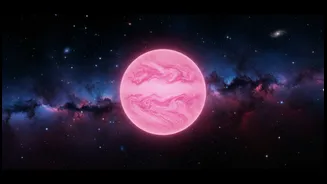
The phenomenon of salt in space isn’t limited to our solar system. Very recently, astronomers using the James Webb Space Telescope turned their gaze to a distant world nicknamed the 'Pink Planet', or GJ 504 b, located 57 light-years away. This massive, cold gas giant presented a puzzle; its atmospheric data didn't make sense with standard models. The breakthrough came when researchers realized the planet's atmosphere is likely filled with clouds made not of water, but of minerals like potassium chloride and zinc sulfide—essentially, salt clouds. These exotic clouds obscure the deeper layers of the atmosphere, shaping the light that reaches our telescopes. This discovery was a revelation, confirming long-held theories that such clouds could exist in the atmospheres of worlds that are too cool for silicate (rock) clouds but too hot for water clouds. It fundamentally changes how scientists will study the atmospheres of cold exoplanets going forward.
The 'Weather' in Space Weather
So, what does this have to do with weather? The term 'space weather' describes the constantly changing conditions in space, driven by winds, radiation, and magnetic fields from stars like our Sun. Just as terrestrial weather involves the movement of air and water, space weather involves the flow of charged particles, or plasma. When salty material from a moon like Europa is ejected into space, perhaps through plumes from its ocean, it gets caught in Jupiter's immense magnetic field. The salt particles become ionized—electrically charged—and join the torrent of plasma that constitutes Jupiter's local space weather. This interaction is so powerful that it leaves a visible 'footprint' in Jupiter's magnificent auroras. Studying these interactions helps scientists understand the complex electrical and magnetic environments around other planets, providing a crucial model for understanding our own.
Why This Matters for India
The study of space weather is not just an academic exercise; it has real-world consequences here on Earth. Powerful solar events can trigger geomagnetic storms that pose significant risks to our technology-dependent society. These storms can disrupt satellite communications, affect GPS and navigation systems like India's own NavIC constellation, and even damage power grids. As India expands its presence in space with more satellites for communication, Earth observation, and defence, understanding and forecasting space weather becomes a critical aspect of national security and infrastructure resilience. By studying the extreme space weather around planets like Jupiter and the atmospheric conditions on distant worlds, we gain invaluable data that helps us refine the models used to predict solar storms and protect our vital assets in orbit and on the ground.