





A Glimmer of Hope in 2019
Our story begins in 2019 with data from NASA's Transiting Exoplanet Survey Satellite, or TESS. The satellite is designed to spot distant worlds by watching for tiny, periodic dips in a star’s brightness, a tell-tale sign of a planet passing in front of it.
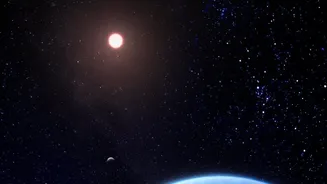
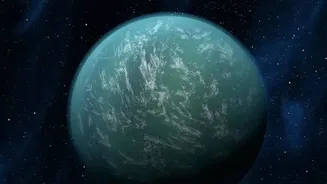
In a star system hundreds of light-years away, TESS registered just such a dip. The potential planet was designated TOI-2535 b, with 'TOI' standing for 'TESS Object of Interest'. The initial data was thrilling. The size of the dip suggested a planet perhaps only slightly larger than Earth, and its distance from its star hinted that it could be in the 'habitable zone', where conditions might be right for liquid water. For astronomers, this was a top-tier candidate, exactly the kind of world TESS was built to find. The global scientific community buzzed with excitement, and plans were quickly drawn up for the essential next step: confirmation.
The Puzzling Silence
An 'Object of Interest' is not a confirmed planet; it is a lead that must be followed up. From 2020 onwards, astronomers at observatories around the world turned their powerful ground-based telescopes toward the parent star of TOI-2535 b. They were trying to do two things: catch another transit to confirm the planet's orbit and use a technique called radial velocity to measure the star's 'wobble' from the planet's gravitational pull. But this is where the mystery began. The predicted times for the next transit came and went, with no discernible dip in starlight. Follow-up observations were scheduled, instruments were recalibrated, and still, nothing. TOI-2535 b was a no-show. Furthermore, the sensitive radial velocity measurements failed to detect any gravitational tug. For several years, the promising candidate remained stubbornly silent, its existence thrown into serious doubt. It was as if it had been a ghost in the data.
Theories for a Vanishing World
By 2024, the conversation had shifted from confirmation to explanation. Where did TOI-2535 b go? The leading theory is that it was never a planet at all. The original TESS detection could have been a 'false positive'. One common culprit for this is a background eclipsing binary—a pair of stars far behind the target star that orbit each other, creating a faint dip in light that gets blended with the target star's light, perfectly mimicking a planet. Another possibility is stellar activity. The star itself might have had a massive, slow-moving 'starspot' (a cooler, darker patch on its surface) that rotated into view, causing the one-time dip that TESS saw. These phenomena are common pitfalls in the exoplanet hunting game, and filtering them out is a crucial part of the scientific process.
What 'Missing' Really Means in 2026
Today, in late 2026, TOI-2535 b is officially classified as a retired candidate, filed away as a likely false positive. Yet, a few more exotic and intriguing possibilities keep the case file from being permanently closed. Some scientists have modeled scenarios where the object was not a planet but a massive cloud of dust and debris from a collision between asteroids, which has since dispersed. Another, more remote theory is that TOI-2535 b is a real planet but on a bizarre, highly eccentric orbit. It might swing close to its star for one transit and then fly far out into its system, not to return for decades. If that's the case, it isn't missing, just hidden. We would simply have to wait, perhaps for a very long time, for it to reveal itself once more. This ambiguity is what makes the story so compelling.