




The Solar System’s Reigning Monarch of Moons
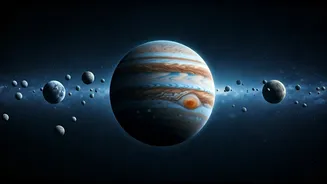
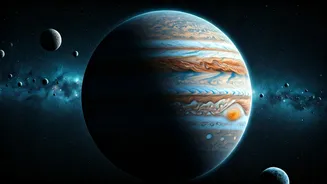
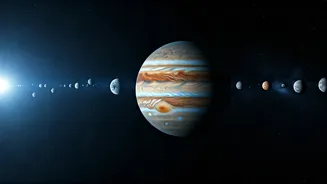
For a long time, Saturn was the undisputed leader in the moon race, but Jupiter has officially reclaimed the crown. As of early 2026, the International Astronomical Union (IAU) has confirmed a staggering number of moons orbiting the gas giant, with the count
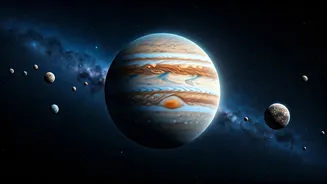
now standing at 115. [2] This number has grown rapidly in recent years, jumping from 79 in 2018 to 92 in early 2023, and crossing the 100-moon threshold with new confirmations in 2026. [2, 5, 12] These discoveries are a testament to how powerful modern telescopes have become, allowing astronomers like Scott Sheppard and his team to spot tiny objects, some barely a kilometer wide, from millions of kilometers away. [4, 5] While the headline figure is impressive, it only scratches the surface of the complexity and diversity of the Jovian system. [3]
A Tale of Two Families: The Giants and the Irregulars
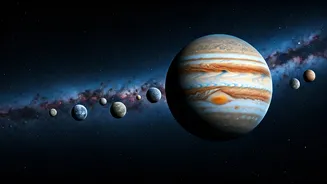
Jupiter’s moons can be broadly split into two distinct categories. First are the famous Galilean moons—Io, Europa, Ganymede, and Callisto—discovered by Galileo Galilei in 1610. [1, 16] These four are planetary-mass objects, large enough to be spherical, and contain the vast majority (99.997%) of the total mass orbiting Jupiter. [1, 2] Ganymede is the largest moon in the entire solar system, even bigger than the planet Mercury. [1] The second group consists of the dozens of smaller, much more numerous 'irregular' satellites. [2, 4] These are not neat, spherical worlds but lumpy, asteroid-like bodies with distant, eccentric, and often highly inclined orbits. Many even orbit Jupiter 'backwards' in what is known as a retrograde motion. [17] It’s believed these tiny moons are not native to Jupiter but are asteroids or comet fragments that were snared by the planet’s immense gravity long ago. [13, 17]
What Does 'Active' Really Mean?
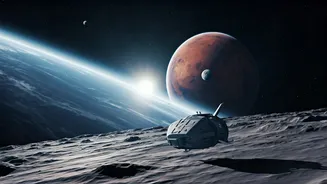
The term “active” can be interpreted in two ways. When astronomers talk about an 'active moon', they are often referring to geological activity. In this sense, Jupiter has some of the most active worlds imaginable. Io is the most volcanically active object in the solar system, with hundreds of volcanoes constantly spewing lava and sulfurous gas, powered by the immense gravitational tug-of-war between Jupiter and its neighbouring moons. [1, 8, 9] Europa is also considered active, with strong evidence suggesting a vast liquid water ocean churns beneath its icy crust, potentially warmed by tidal heating. [7, 19] However, when discussing the 90+ moons, the term “active” is more likely being used in a simpler sense: these are objects in an active, confirmed orbit around the planet. Discovering a new speck of light near Jupiter is one thing; confirming through repeated observations over months or years that it has a stable orbit is the crucial step to it being officially recognised as a moon by the IAU's Minor Planet Center. [4, 5]
How We Find These Tiny Worlds
Discovering these small, faint moons is a painstaking process. Astronomers use powerful ground-based telescopes, like those in Hawaii and Chile, to survey the sky near Jupiter. [4, 5] The teams aren't always explicitly looking for new moons; often, the discoveries are byproducts of searches for more distant objects in our solar system, like the hypothetical Planet Nine. [4] When a new, slow-moving point of light is detected near Jupiter, the real work begins. Astronomers must track the object over an extended period—sometimes years—to precisely map its orbit and confirm it is truly bound by Jupiter's gravity. [4] This follow-up work is challenging because the tiny moons are incredibly faint and often lost in the intense glare of Jupiter itself. Only after its orbit is known with certainty will the Minor Planet Center officially recognize it as a new moon. [4, 5]
Why These Small Moons Matter
While not as dramatic as their larger siblings, the small irregular moons are scientifically priceless. Because they are thought to be captured objects, they serve as pristine relics from the early solar system. [17] Studying their composition and orbital families—groups of moons with similar paths, likely formed from a single larger body that shattered—gives us clues about the environment around Jupiter billions of years ago. [4] They help scientists understand the chaotic process of planet formation and how giant planets like Jupiter gravitationally sculpted the solar system we see today. [19] These tiny worlds are not just a numbers game; they are a fossil record of our cosmic history, waiting to be read by missions like the European Space Agency's Juice and NASA's Europa Clipper, which are set to explore the Jovian system in the 2030s. [16]