




Meet the CHIME Telescope
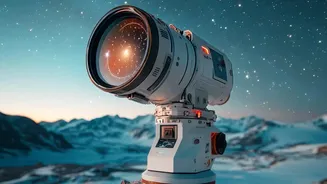
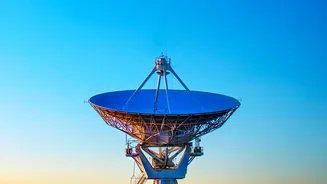
The instrument behind this incredible feat is the Canadian Hydrogen Intensity Mapping Experiment, or CHIME. Located in British Columbia, Canada, CHIME doesn't look like a typical satellite dish telescope. It consists of four large, stationary half-pipe
reflectors, each 100 metres long. With no moving parts, it scans the entire northern sky every single day as the Earth rotates. Its main goal is to map the most abundant element in the cosmos: hydrogen. By tracking the faint radio glow of hydrogen gas, CHIME can create a three-dimensional map of the universe, allowing scientists to study its large-scale structure and expansion history. It’s built with clever, cost-effective technology, including components from the mobile phone and video game industries, making it a powerful tool for scanning the heavens.
The Whispers of Ancient Hydrogen
The major breakthrough highlighted in recent research is CHIME's first-ever standalone detection of the faint radio signal from hydrogen gas when the universe was about five billion years old — meaning the signal has been travelling for around nine billion years to reach us. Previously, to confirm such distant signals, CHIME had to cross-reference its data with more expensive optical telescope surveys. This independent detection proves that CHIME’s method works on its own, providing a faster and cheaper way to probe cosmic history. The signal was incredibly faint, buried in noise from human technology and the universe itself. It took researchers more than a year of meticulous data processing and testing to confirm the signal was real.
More Than Just Hydrogen: The Mystery of FRBs
While mapping hydrogen is its primary mission, CHIME's unique design has also made it an unparalleled instrument for detecting Fast Radio Bursts (FRBs). FRBs are one of the most exciting mysteries in modern astronomy. They are incredibly powerful, fleeting blasts of radio waves, lasting only milliseconds, but can release as much energy in that instant as the Sun does in three days. Their exact cause is unknown, but leading theories point to highly-magnetised neutron stars called magnetars. The most distant FRB detected to date, FRB 20220610A, also came from when the universe was just five billion years old. This particular burst was traced back to a compact group of at least seven interacting galaxies, a rare and surprising environment for such an event.
A New Toolkit for Cosmology
Detecting these ancient signals—both the steady glow of hydrogen and the sudden flash of FRBs—is more than just a cosmic novelty. It opens up an entirely new research path for understanding the universe. By measuring how these signals have stretched and dispersed over their vast journey, scientists can map the matter they passed through. This allows them to 'weigh' the universe and study the distribution of matter between galaxies. More importantly, this technique provides a new way to investigate dark energy, the mysterious force believed to be causing the universe's expansion to accelerate. By providing an independent method to measure cosmic expansion, CHIME can help test competing theories about this enigmatic force.