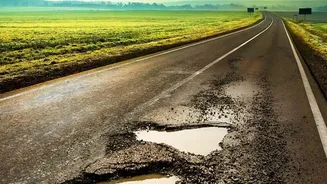






The Perennial Pothole Problem
Every year, heavy rains and traffic transform smooth city roads and national highways into obstacle courses. The cycle is frustratingly predictable: water seeps into small cracks in the asphalt, traffic pressure widens them, and soon, a pothole is born.
This leads to costly, disruptive, and seemingly endless repairs. For decades, the solution has been to simply patch the holes, a temporary fix that often fails with the next downpour. But engineers and scientists are now looking beyond the patch, developing road surfaces that are not only more durable but can also heal themselves.
What Makes Asphalt 'Bio'?
A key innovation gaining traction in India is bio-bitumen. Bitumen is the black, sticky binder that holds the stones in asphalt together, and it's traditionally derived from petroleum. India imports nearly half of its bitumen, making road construction vulnerable to global oil prices. To tackle this, Indian institutions like the CSIR-Central Road Research Institute (CRRI) have pioneered bio-bitumen made from agricultural waste. This 'waste-to-wealth' approach uses materials like rice straw, a major contributor to air pollution when burned by farmers, and converts it into a valuable road-building material. This not only reduces our reliance on imported fossil fuels but also creates a new income stream for farmers and helps clear the air.
The Science of Self-Healing
The other side of this revolution is the 'self-healing' capability. Imagine a road that can fix its own minor injuries before they become major problems. There are several ways to achieve this. One popular method involves embedding tiny microcapsules filled with a rejuvenating agent, such as bio-oils like sunflower oil, into the asphalt mix. When a micro-crack forms, it ruptures the capsules, releasing the oil. This oil softens the aged, brittle bitumen around the crack, allowing it to flow and rebond, effectively sealing the damage from within. Another high-tech approach involves adding conductive steel fibers to the asphalt. When cracks appear, an induction heating machine passes over the road, warming the fibers. This heat softens the bitumen just enough to close the cracks, essentially healing the road without any new material.
From the Lab to Indian Highways
This technology is no longer just theoretical. India is actively beginning to adopt these greener materials. The home-grown bio-bitumen technology, developed by CSIR-CRRI in collaboration with the CSIR-Indian Institute of Petroleum, has been formally transferred to companies for commercial production in early 2026. Pilot projects are already demonstrating its real-world viability. Successful trial stretches have been laid using bio-bitumen on key national highways, including a section on the Jorabat-Shillong Expressway and near Nagpur, to test its performance under heavy traffic and diverse weather conditions. These projects are the first step towards wider adoption, moving from small trials to potentially thousands of kilometres of more sustainable roads.
The Benefits and Bumps Ahead
The advantages are compelling. Studies suggest self-healing technologies can extend the lifespan of a road by 30% or more, drastically cutting down long-term maintenance costs. Fewer repairs mean less traffic disruption, lower labour costs, and improved road safety. Environmentally, the benefits are two-fold: bio-bitumen reduces reliance on fossil fuels and gives a second life to agricultural waste, while self-healing properties reduce the need for carbon-intensive repair work. However, challenges remain. The initial cost of these advanced asphalts can be higher than conventional mixes. Furthermore, the technology needs to be proven over many years across India's varied and extreme climates to establish clear standards for its widespread use.