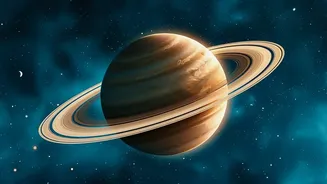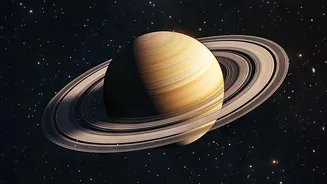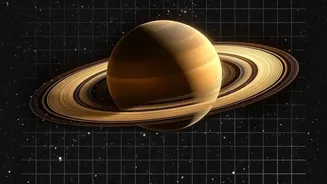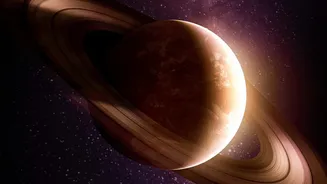





A Planet of Geometric Storms
When we think of Saturn, we picture its breathtaking rings. But for planetary scientists, some of its most fascinating features are the colossal, oddly shaped storms raging in its atmosphere. The most famous of these is a massive, six-sided jet stream
at the planet's north pole. Known as 'the hexagon,' this atmospheric pattern was first spotted by the Voyager spacecraft in the early 1980s and has remained remarkably stable for over 40 years. The sides of this structure are wider than Earth itself, and it rotates with the planet like a fixed, spinning vortex. For decades, scientists wondered if this was a one-of-a-kind anomaly in the solar system, a planetary quirk unique to Saturn's north pole.
A Surprise at the South Pole
The solar system, it turns out, had another surprise in store. In early September 2026, a team of researchers announced the discovery of a brand-new shape at Saturn's opposite pole: a decagon. This giant, 10-sided atmospheric wave was spotted circling the planet's southern hemisphere. The discovery came after Saturn's south pole, shrouded in winter darkness for over a decade, tilted back toward Earth, allowing for fresh observations. Faint hints of the structure were first noticed in 2024 by amateur astronomers, with their findings later confirmed and detailed by professional scientists using the powerful Hubble Space Telescope. Unlike its long-standing northern counterpart, this decagon appears to be a recent arrival, having seemingly formed between 2023 and 2025.
What Scientists Know So Far
While the discovery is new, scientists have quickly pieced together some key facts. The decagon is an atmospheric wave embedded within a powerful jet stream, where winds whip around the planet at roughly 400 kilometres per hour. It is not just a pattern on the cloud tops; observations at different wavelengths reveal it is a deep, three-dimensional structure that extends vertically through multiple layers of Saturn's atmosphere. This confirms it is a significant, large-scale phenomenon. Researchers believe that, like the hexagon, the decagon is a meandering wave in the jet stream, where perturbations cause the airflow to settle into a stable geometric pattern. This kind of behaviour has even been replicated in laboratory experiments using spinning tanks of liquid.
The Unanswered Questions
The existence of the decagon answers one question—that the hexagon is not a complete anomaly—but it opens up a host of new mysteries. Chief among them is: why did it form now? The Cassini spacecraft orbited Saturn from 2004 to 2017 and saw no trace of a persistent polygon at the south pole, making the decagon's recent emergence a genuine puzzle. Another key question is, why ten sides? Its northern sibling has six. The difference may be linked to its location at a lower latitude (around 60 degrees south, compared to the hexagon's 78 degrees north) or the specific structure of the jet stream in that region. One leading hypothesis suggests a nearby anticyclonic vortex—a high-pressure storm—may have provided the initial disturbance that kicked off the wave's formation. Scientists also don't know what chemicals create its distinct colour or how stable it will prove to be.