



The Challenge of Seeing Underwater
For marine archaeologists, the ocean is a formidable opponent. Murky water, strong currents, and immense pressure make direct exploration difficult, dangerous, and incredibly slow. For decades, the primary method involved sending divers down, essentially
searching for a needle in a haystack with limited visibility. While legends and ancient texts, like the Silappathikaram, spoke of glorious cities like Poompuhar being swallowed by the sea, verifying these claims was a monumental task. The sheer scale of the ocean floor and the layers of sediment deposited over centuries meant that even large structures could remain hidden just a few metres away from a diver.
Painting Pictures with Sound
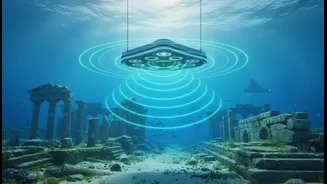
Enter sonar, which stands for Sound Navigation and Ranging. The basic principle is simple: a device sends out a pulse of sound and listens for the echo. By measuring the time it takes for the echo to return, scientists can calculate the distance to an object. Early sonar, known as single-beam, could only tell you the depth directly below the research vessel. While useful, it was like mapping a forest by looking at one tree at a time. It could easily miss significant features lying between its pings.
The Game-Changers: Multibeam and Side-Scan Sonar
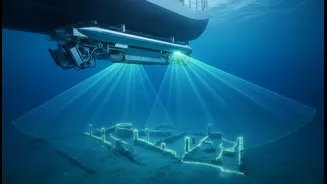
Modern archaeological surveys off the Tamil Nadu coast now employ much more sophisticated tools. The two primary technologies are Multibeam Echosounders (MBES) and Side-Scan Sonar. A multibeam system sends out a wide, fan-shaped array of sound beams, covering a large swath of the seabed with every pass. This doesn't just create a line of depth points; it generates a detailed, three-dimensional topographic map of the ocean floor, revealing its contours with incredible precision. Side-scan sonar works in a complementary way. It is typically towed behind a vessel in a device called a 'towfish'. It emits fan-shaped pulses out to the sides, creating a black-and-white image similar to an aerial photograph. It doesn't measure depth as well as a multibeam system, but it excels at showing the texture and composition of the seabed. Hard objects, like stone walls, create strong reflections (appearing lighter), while soft sediment absorbs the sound (appearing darker).
Revealing the Lost City of Poompuhar
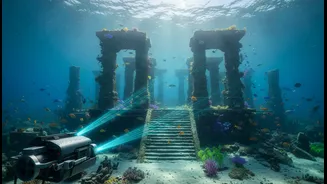
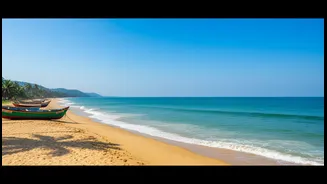
The legendary port city of Poompuhar, or Kaveripoompattinam, is a primary target for these high-tech surveys. This Sangam-era city was a major maritime trade hub, and literature describes it as being lost to the sea. Recent explorations by institutions like the National Institute of Ocean Technology (NIOT) and the Tamil Nadu State Department of Archaeology (TNSDA) have used sonar to systematically map the area. Sonar surveys have identified several man-made structures, including U-shaped formations and scattered stone blocks, at depths of up to 23 metres. The data has also revealed a submerged palaeochannel of the river Kaveri, which provides crucial geological context for where a city might have been located. By combining multibeam data (the 'what' and 'where') with side-scan images (the 'shape' and 'texture'), researchers can identify anomalies that are unlikely to be natural formations.
From Anomaly to Artefact
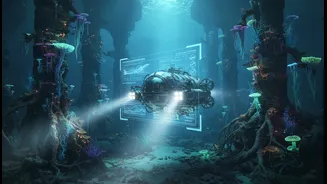
Sonar simplifies the initial, most time-consuming part of the process: finding where to look. It allows teams to survey hundreds of square kilometres quickly and efficiently. Once the sonar data highlights a promising anomaly—a strangely geometric shape or a hard reflection where there should be sand—archaeologists can deploy more targeted methods. This is where Remotely Operated Vehicles (ROVs) equipped with cameras come in, providing visual confirmation without risking a diver. Divers are then sent to these precise, pre-identified locations to conduct physical inspections, take measurements, and recover artefacts. This focused approach is far safer and more productive than speculative diving. Thanks to sonar, archaeologists are no longer searching blindly; they are conducting targeted investigations based on a detailed map of a world that has been hidden for millennia.