

The Silent, Persistent Threat
For robotic missions on Mars, the greatest enemy isn’t aliens, but something far more mundane: dust. The Red Planet is covered in a fine, talc-like powder that is electrostatically charged, meaning it sticks to everything. For solar-powered landers and rovers,
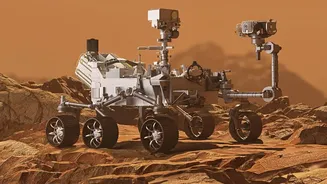
this is a potentially fatal problem. As a thin film of dust accumulates on solar panels, it blocks sunlight, slowly starving the spacecraft of energy. We've seen this happen before. NASA’s InSight lander, which studied the Martian interior for four years, ultimately succumbed to power loss in late 2022 as its solar arrays became increasingly coated in dust. The famed Opportunity rover was lost in 2018 after a planet-encircling dust storm blotted out the sun and caked its panels. While some might ask why these robots don't have wipers, the answer comes down to weight and complexity; every gram is precious on a mission to Mars, and a cleaning system means less room for science instruments.
An Eye in the Sky
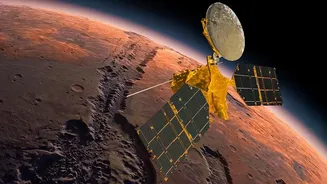
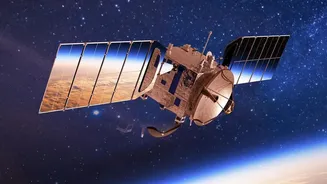
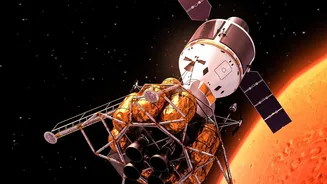
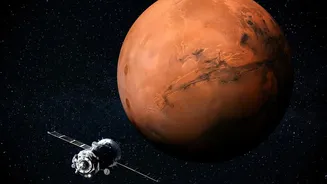
Protecting these valuable assets requires a better understanding of Martian weather, specifically how dust moves. That’s where NASA’s Mars Reconnaissance Orbiter (MRO) comes in. Orbiting Mars since 2006, MRO is equipped with the most powerful telescopic camera ever sent to another planet: the High-Resolution Imaging Science Experiment, or HiRISE. From an altitude of hundreds of kilometers, HiRISE can spot features on the surface as small as a coffee table. While its primary mission involves mapping the Martian surface in stunning detail, scientists have adapted its use to become a crucial tool for atmospheric science and mission safety. By taking repeated images of the same locations, researchers can monitor changes on the surface and in the atmosphere, providing an unprecedented view of Martian dust activity.
Decoding Dust Pulses
The “dust pulses” scientists are tracking are often dust devils—swirling columns of air and dust similar to small tornadoes on Earth. These vortices are created when the ground heats up, causing warm air to rise rapidly and spin, sucking up loose dust from the surface. While the MRO's cameras can't see the wind itself, they can clearly see the aftermath: the dark tracks left behind as dust devils scour the lighter-colored dust off the surface, exposing the darker rock beneath. In some cases, the HiRISE camera has been powerful enough to capture images of active dust devil plumes, which can be dozens of meters wide and stretch kilometers into the thin Martian sky. By analyzing these tracks and plumes over time, scientists can build a map of where and when these dust events are most common, creating a vital database on Martian weather patterns.
A Weather Forecast for Robots
This orbital surveillance translates into a kind of weather forecasting service for robots on the ground. Understanding dust devil activity is a double-edged sword. On one hand, large regional or global dust storms are a clear danger, reducing power for all solar-dependent assets. On the other hand, a passing dust devil can be a stroke of luck. The powerful winds can act as a cleaning event, blowing accumulated dust off solar panels and giving a mission a new lease on life. This happened repeatedly for the Spirit and Opportunity rovers, dramatically extending their missions. By studying data from MRO, mission planners can better understand the probability of these cleaning events at different landing sites. This information is crucial for managing power consumption, scheduling science operations, and maximizing the lifespan of current and future missions.
The Future of Martian Exploration
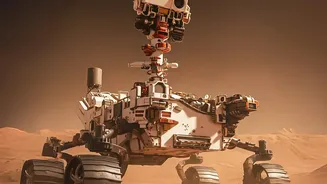
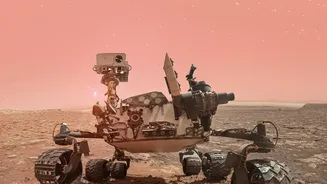
The effort to understand Martian dust isn't just about protecting our current robotic explorers; it's essential for the future of human exploration. While some rovers like Curiosity and Perseverance are nuclear-powered and less vulnerable to dust-related power loss, they still carry weather instruments to study the atmosphere. The data gathered by MRO and surface missions are being fed into increasingly sophisticated climate models, some using machine learning, to improve forecasting accuracy. Knowing how to predict major dust storms, where they originate, and how they spread will be critical for the safety of astronauts living and working on Mars. Before humans set foot on the Red Planet, we need to be confident that we can anticipate its most hazardous weather, and the watchful eye of our orbital cameras is a key part of that endeavor.