

The Life and Death of a Star
Stars are giant celestial factories powered by nuclear fusion. For most of their lives, they fuse hydrogen into helium in their cores. The outward pressure from this energy perfectly balances the inward crush of gravity. But for stars much more massive
than our Sun—at least eight times larger—this is just the beginning. Once they exhaust their hydrogen, they begin fusing heavier elements: helium into carbon, carbon into neon, and so on, creating onion-like layers of different elements inside the star. This process continues until the core is composed of iron. Unlike lighter elements, fusing iron doesn't release energy; it consumes it. With its fuel source gone, the star loses its fight against gravity, and the core collapses catastrophically in a matter of seconds.
The Supernova: An Explosive Finale
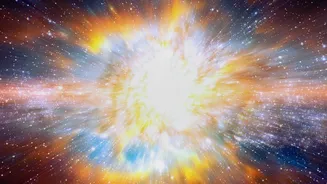
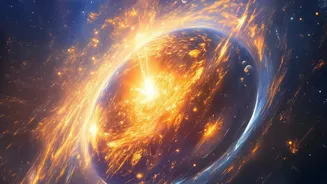
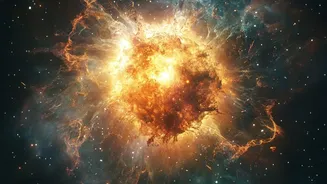
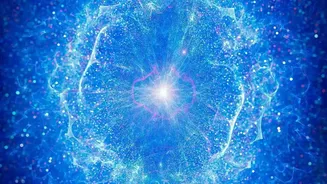
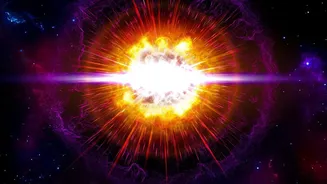
The core's sudden collapse triggers a monumental shockwave that blasts the star's outer layers into space in a brilliant explosion known as a core-collapse supernova. For a few weeks, the supernova can be brighter than all the other stars in its galaxy combined. These explosions are not just beautiful; they are cosmically essential. They forge elements heavier than iron and scatter them across the galaxy. This stardust enriches the interstellar medium, providing the raw materials for new stars, new planets, and eventually, life itself. The iron in your blood was forged in the heart of a long-dead star and flung into space by a supernova.
Cosmic Ghosts: Neutron Stars and Black Holes
After the outer layers are gone, a dense stellar corpse remains. What's left depends on the original star's mass. If the star was between about eight and 20 times the mass of the Sun, the core collapses into an incredibly dense object called a neutron star. This city-sized sphere packs more mass than our Sun, and a single teaspoon of its material would weigh billions of tonnes. If the original star was even more massive, gravity wins completely. The core collapses indefinitely, forming a stellar-mass black hole—an object so dense that not even light can escape its gravitational pull.
A 'New Star' Appears in 1604
In October 1604, skygazers across Europe, China, and Korea noticed a brilliant 'new star' in the constellation Ophiuchus. It shone brighter than any star or planet, even being visible during the day for over three weeks. German astronomer Johannes Kepler observed it extensively, and his detailed work, 'De Stella Nova' (On the New Star), led to the event being named Kepler's Supernova, or SN 1604. It remains the most recent supernova to be observed with the naked eye in our own Milky Way galaxy. At the time, it challenged the prevailing Aristotelian idea that the heavens were perfect and unchanging.
Kepler's Remnant Today
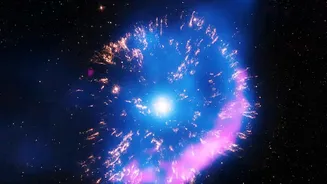
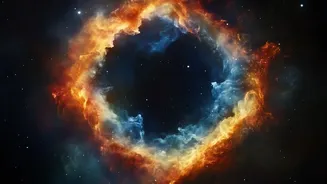
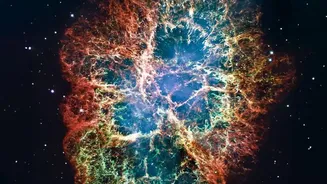
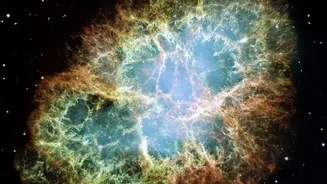
While Kepler and his contemporaries witnessed a star's death, modern astronomers study its ghost. Today, powerful telescopes like NASA's Chandra X-ray Observatory see an expanding, turbulent cloud of gas and dust where the star once was—Kepler's Supernova Remnant. By studying the light and elements within this remnant, astronomers have pieced together the story. SN 1604 was a specific kind of explosion called a Type Ia supernova. This happens not from a massive star's core collapse, but when a white dwarf—the remnant of a smaller, Sun-like star—gains too much mass from a companion star and explodes in a runaway thermonuclear reaction. The remnant shows a shell-like structure, still expanding outwards into space over 400 years later.
Why These Explosions Still Matter
Studying supernova remnants like Kepler's offers a direct window into the physics of these extreme events. They are cosmic laboratories for understanding how stars die, how elements are created and dispersed, and how shockwaves accelerate particles to nearly the speed of light. Furthermore, because Type Ia supernovae like SN 1604 always explode with a similar, predictable brightness, they are used by astronomers as 'standard candles' to measure vast distances across the universe. These measurements have been crucial in discovering that the expansion of the universe is accelerating. So, the ghost of a star that fascinated Kepler centuries ago is still teaching us about the fundamental nature of our cosmos.