





A New Shape in the South
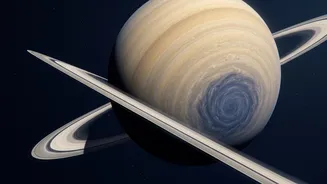
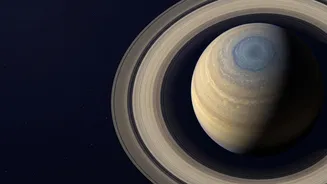
Recent observations from the Hubble Space Telescope have confirmed the existence of a huge, 10-sided atmospheric wave, or decagon, encircling Saturn's south pole. This surprising discovery was detailed in a study published in the journal Science Advances
in early September 2026. The feature was first hinted at in 2024 and 2025 images collected by a network of professional and amateur astronomers led by Agustín Sánchez-Lavega at the University of the Basque Country. When Saturn's southern hemisphere tilted back toward Earth after years of being hidden from view, these observers noticed a faint, wavy pattern. High-resolution Hubble data confirmed their suspicions, revealing a distinct decagonal structure that appears to have been forming since at least 2023.
An Evolving Mystery
Unlike the northern hexagon, which has been a stable fixture for over 40 years, this southern decagon is a new development. NASA's Cassini spacecraft, which orbited Saturn from 2004 to 2017, saw no evidence of such a long-lived, polygonal structure at the south pole. This suggests the decagon formed sometime after Cassini's mission ended. Scientists are excited because this gives them a rare, real-time opportunity to watch a massive planetary weather system develop and strengthen. The decagon is not just a pattern on the cloud tops; data shows it is a vertically extended wave that penetrates through multiple layers of the atmosphere, indicating a deep and powerful structure.
How Do Planets Create Polygons?
While these geometric shapes seem unnatural, they are the product of fluid dynamics on a planetary scale. The patterns are believed to be standing waves locked within powerful jet streams that circle the planet's poles. On Earth, jet streams meander in unstable waves, but on gas giants like Saturn, with their faster rotation and different atmospheric conditions, these waves can sometimes settle into stable, polygonal shapes. Laboratory experiments have managed to replicate the hexagonal shape by spinning a circular tank of liquid at different speeds. The emergence of a decagon suggests that the conditions in Saturn's atmosphere are uniquely suited to forming these geometric wonders, though scientists are still working to understand the precise forces that create ten sides instead of six.
Two Poles, Two Different Stories
The discovery of a southern polygon proves that the northern hexagon is not a complete anomaly. However, the two features are not identical. The northern hexagon is practically stationary, while the southern decagon appears to be migrating slowly eastward. Scientists speculate that the decagon's formation might be linked to a nearby high-pressure vortex, a smaller version of Jupiter's Great Red Spot, that could be forcing the wave into its 10-sided pattern. The key question now is whether the decagon will stabilize and persist for decades like the hexagon, or if it is a more temporary feature that will eventually break apart. Answering this will reveal crucial new information about Saturn's atmospheric dynamics and why its two poles tell such different weather stories.