






The New Digital Tutors
Not long ago, getting a final check on a research paper meant pleading with a friend or spending hours poring over grammar books. Today, student researchers are turning to a new assistant: artificial intelligence. AI checkers are sophisticated tools that
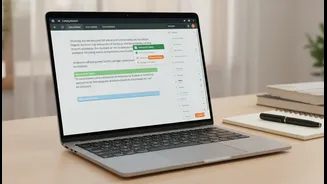
go far beyond the basic spell check in your word processor. Platforms like Grammarly, QuillBot, and others have become common companions for students across India. These tools use advanced algorithms to analyse text not just for grammatical errors and typos, but also for style, clarity, tone, and even plagiarism. Some, like QuillBot, specialize in paraphrasing complex sentences to improve flow, while others, like Grammarly, focus on ensuring polished, error-free prose. For many students, especially those for whom English is not their first language, these tools can feel like a lifeline, helping them express their complex ideas with the clarity and confidence that academic standards demand. They offer instant feedback, suggesting alternative phrasing and highlighting awkward sentences, acting like a 24/7 digital tutor.
The Promise of a Perfect Paper
The benefits of using AI checkers are immediately obvious. They help eliminate embarrassing typos and grammatical mistakes that can undermine the credibility of an otherwise brilliant research paper. By flagging wordy sentences and suggesting more concise alternatives, they improve overall readability. This is particularly helpful in scientific and technical writing, where precision is key. For students navigating the high-stakes environment of academic publishing, these tools can level the playing field, allowing their research to be judged on its merit, not on their command of English idioms. Furthermore, these tools can be a powerful learning aid. By explaining the reasoning behind a grammatical correction, they teach students the rules of academic writing in a practical, contextual way. Instead of just passively accepting changes, a proactive student can learn to identify their own common mistakes and improve their writing skills over time. The goal is to use the AI's feedback to become a better writer, not to let the AI do the writing for you.
The Hidden Risks and University Rules
However, this new technology comes with significant risks. The biggest danger is over-reliance. Using AI to generate or heavily rewrite entire sections can strip a paper of its original thought and lead to accusations of academic misconduct. Moreover, many Indian universities now use sophisticated AI detection tools like Turnitin, which are designed to spot the statistical fingerprints of AI-generated text. Getting flagged can lead to serious consequences, from a failing grade to disciplinary action. The policies on AI use are still evolving and vary widely between institutions. A recent survey showed that while over 60% of higher education institutions in India permit the use of AI tools, they often come with strict conditions. Some universities may allow AI for proofreading but prohibit it for generating text, requiring students to disclose any tools used. With the majority of Indian universities not yet fully prepared to handle the nuances of AI-generated content, students walk a fine line. The safest approach is to always check your specific university and department's academic integrity policy before using any AI tool.
A Smart Student's Guide to Ethical AI
So, how can a student researcher use these tools effectively and ethically? The key is to treat them as an assistant, not a replacement for your own intellect.
First, write your own draft. Develop your arguments and structure your thoughts in your own words. Use the AI checker only during the revision and polishing stage. This ensures the core ideas and analysis remain yours. Second, be critical of the suggestions. AI is not perfect; it can misunderstand context, especially with discipline-specific terminology, and offer awkward or incorrect changes. Always ask yourself if a suggestion actually improves the sentence or just makes it different. Third, use the tool to learn. When an AI checker flags an error, take a moment to understand why it's wrong. This turns a simple correction into a mini-lesson, strengthening your own skills. Finally, be transparent. If your university's policy is unclear, it is always best to have an open conversation with your guide or professor about the tools you are using to improve your work.