


The Robotic Vanguard: Cost and Efficiency
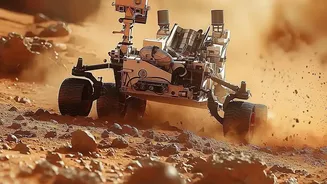
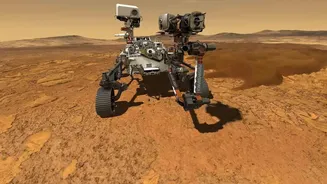
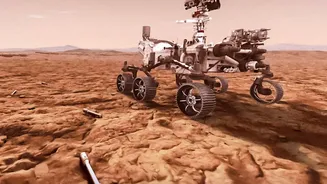
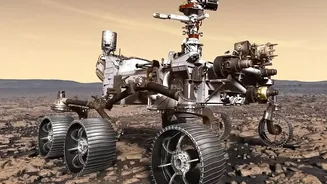
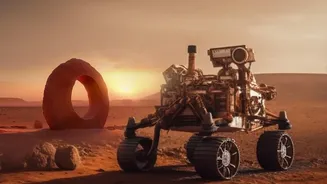
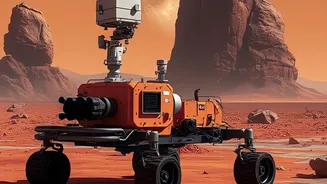
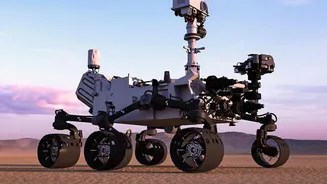
When it comes to exploring Mars on a budget, robots are the undisputed champions. Missions like NASA's Perseverance rover, which landed in 2021, come with a price tag of around $2.7 to $2.9 billion. While hardly inexpensive, this is a fraction of the cost
projected for a human mission. The reason for the massive price difference is simple: robots don't need to stay alive. They require no food, water, or breathable air. There is no need for a return journey, and they can be packed into a much smaller and lighter spacecraft, dramatically reducing launch costs. These robotic geologists can operate for years, patiently gathering data and surviving in an environment that would be instantly lethal to an unprotected human.
The Limits of Automation
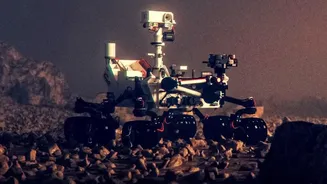
Despite their cost-effectiveness, robotic explorers have significant limitations. The most glaring issue is the communication delay. Depending on the planets' alignment, a signal from Earth can take between four and 24 minutes to reach Mars, making real-time control impossible. This means every action must be meticulously planned and uploaded in advance. A rover can't react instinctively to a sudden discovery or navigate a treacherous patch of terrain with human-like agility. Their speed is also incredibly slow; the Curiosity rover moves at a maximum of 0.14 kilometres per hour. If a robot gets stuck or a critical component fails, there is no one there to fix it, potentially ending a multi-billion dollar mission prematurely.
The Human Advantage: Adaptability and Discovery
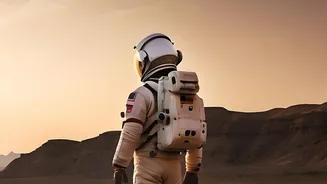
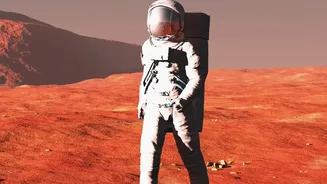
The primary argument for sending humans to Mars is their unparalleled adaptability and intuition. An astronaut geologist could accomplish in minutes what a rover might take an entire day to do. Humans can observe the bigger picture, make connections, and follow scientific hunches in ways no robot currently can. They can break open rocks, dig trenches, and perform complex experiments with a dexterity that is far beyond the reach of automated arms. This ability to react, problem-solve, and make intuitive leaps is considered essential for answering the biggest questions, such as whether life ever existed on Mars. Furthermore, if a critical piece of equipment breaks, a human crew can potentially repair it, saving the mission from failure.
The Ultimate Challenge: Cost and Complexity
Sending humans to Mars is an undertaking of almost unimaginable complexity and cost. Estimates for a single crewed mission range from hundreds of billions to as much as a trillion dollars. The massive cost is driven by the absolute necessity of keeping the crew alive for a mission that could last up to three years. This requires heavy life-support systems, vast stores of food and water, and, most critically, shielding from the constant bombardment of deep-space radiation. The lack of a global magnetic field on Mars means astronauts would be exposed to dangerous levels of cosmic rays, a problem for which no perfect solution currently exists. Beyond the technical hurdles, there are immense physiological and psychological challenges, including muscle atrophy, bone density loss, and the stress of extreme isolation.
A Partnership for the Planets
Ultimately, the debate over robots versus humans is evolving into a conversation about partnership. The consensus among space agencies is that the future of exploration is not an either/or choice, but a synergy between both. Robots are essential precursors, mapping the terrain, testing technologies, and identifying resources like water ice before humans arrive. Experiments like MOXIE on the Perseverance rover have already proven that oxygen can be produced from the Martian atmosphere, a key step for supporting future human crews. Once on Mars, astronauts would likely work alongside a new generation of robotic assistants, which could perform dangerous tasks, carry heavy equipment, and conduct reconnaissance, freeing up the human explorers to focus on science and discovery.