


Why Sitting Wreaks Havoc on Your Hips
When you sit for extended periods, your body adapts to that posture, leading to muscle imbalances that cause stiffness and discomfort. The primary issue is that your hip flexor muscles, which run from your lower back to the front of your thighs, are held
in a shortened position. Over time, these muscles become tight and lose their flexibility. Simultaneously, the opposing muscles, your glutes, become underactive and weak from lack of use. This combination of tight hip flexors and weak glutes pulls your pelvis out of its optimal alignment, increasing stress on the hip joints and lower back, which can lead to pain, reduced mobility, and a feeling of constant stiffness.
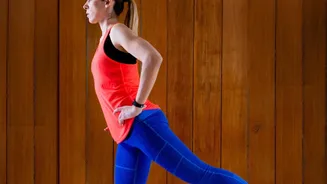
1. Kneeling Hip Flexor Stretch
This classic stretch directly targets the tight muscles at the front of your hips. Start by kneeling on one knee, as if you were about to propose. Your front leg should be bent at a 90-degree angle with your foot flat on the floor, and your back knee should rest comfortably on the ground (use a cushion if needed). Keeping your back straight and your core engaged, gently tuck your tailbone under and slowly push your hips forward. You should feel a gentle stretch in the front of the hip of your back leg. Avoid arching your lower back; the movement should come from the hips. Hold for 30 seconds, then switch sides.
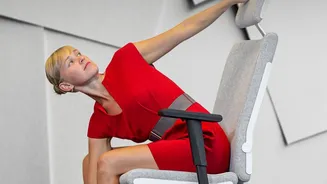
2. Seated Figure-Four Stretch
An excellent stretch for the outer hip and glutes, this can even be done discreetly while sitting in your office chair. While seated, cross one ankle over the opposite knee, creating a 'figure four' shape with your legs. Sit up tall with a straight spine. To deepen the stretch, gently press down on the knee of the crossed leg. For a more intense stretch, you can slowly lean your torso forward while maintaining a flat back. You should feel this in the glute and outer hip of the bent leg. Hold for 30 seconds before switching to the other side.
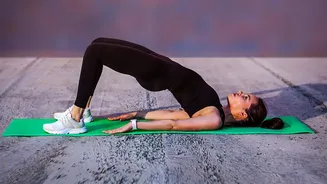
3. Glute Bridge
After stretching the tight hip flexors, it's crucial to activate the weak glutes to restore balance. The glute bridge is a simple yet powerful exercise for this. Lie on your back with your knees bent, feet flat on the floor about hip-width apart, and your arms by your sides. Squeeze your glutes and lift your hips off the floor until your body forms a straight line from your shoulders to your knees. Be careful not to over-arch your back. Hold the position for a few seconds at the top, focusing on the contraction in your glutes, then slowly lower your hips back down. Aim for 10-15 repetitions.
4. Butterfly Stretch
This seated stretch helps to open the hips and stretch the inner thighs (adductors), which can also become tight from sitting. Sit on the floor and bring the soles of your feet together, letting your knees fall out to the sides. Hold onto your ankles or feet. Sit tall, lengthening your spine, and gently encourage your knees toward the floor. For a deeper stretch, you can hinge forward from your hips, keeping your back straight. Breathe into the stretch and hold for 30-60 seconds. Never force your knees down; let gravity do the work.
5. Leg Swings (Dynamic Mobility)
Unlike static stretches, dynamic movements help improve your range of motion and warm up the joints. Stand tall and hold onto a wall or sturdy chair for support. Gently swing one leg forward and backward like a pendulum. Keep the movement controlled, without forcing it, and allow the momentum to gradually increase the height of the swing. Perform 15-20 swings, then switch to the other leg. You can also perform side-to-side leg swings, swinging your leg across the front of your body, to work the hip in a different plane of motion.