



A Sweet Discovery in a Cosmic Cloud
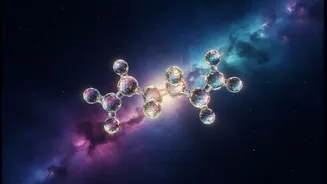
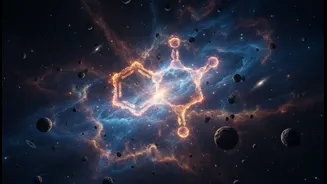
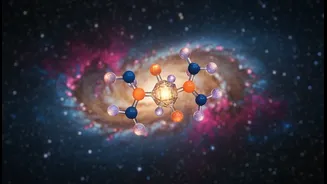
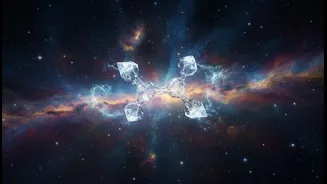
An international team of astronomers has announced a landmark discovery: the first-ever detection of a 'true' sugar molecule in interstellar space. The molecule, known as erythrulose, was identified by its unique radio signature wafting from a vast, turbulent
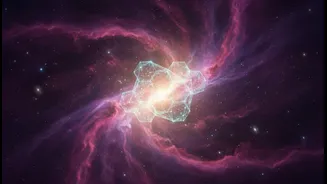
cloud of gas and dust called G+0.693-0.027. This cosmic nursery, located roughly 27,000 light-years away near the supermassive black hole at the centre of our galaxy, is a known chemical factory, but finding this specific ingredient is a particularly exciting development. Using powerful radio telescopes in Spain, researchers, led by a team from the Spanish Center for Astrobiology, were able to pinpoint the four-carbon sugar. While simpler sugar-like molecules have been found before, this is the first time a more complex sugar, a foundational building block for biology, has been confirmed to exist freely between the stars.
Why This Sugar Is a Big Deal
Erythrulose is more than just a sweet find; it’s a vital clue in the story of life. On Earth, sugars are essential. They provide energy, but more importantly, they form the structural backbone of RNA and DNA, the molecules that carry the genetic code for all known living things. For decades, scientists have debated the 'prebiotic soup' theory—the idea that life's ingredients formed on a young Earth. However, many models show that producing complex sugars in the chaotic environment of early Earth would have been incredibly difficult. This discovery provides a compelling alternative. Instead of being cooked up on Earth, what if the key ingredients were delivered from space? Finding erythrulose floating in a star-forming cloud suggests that the building blocks of life are not a local phenomenon but are widespread throughout the cosmos, available to be included in new planets as they form.
The 'Big Origins Clue' Explained
The headline's 'Big Origins Clue' points to the theory of panspermia. This isn't the idea of little green men on asteroids, but the more scientific concept that life's raw materials were delivered to Earth by comets and meteorites billions of years ago. Scientists have already found other crucial ingredients, like amino acids and nucleobases, inside meteorites that have landed on Earth. The discovery of erythrulose in interstellar space strengthens this theory immensely. It shows that complex sugars can form in the cold, harsh vacuum of space, likely on the surfaces of tiny dust grains. These sugar-coated grains can then clump together, becoming part of the comets and asteroids that eventually form alongside new stars and planets. A steady bombardment of these objects on a young, sterile Earth could have supplied the planet with a ready-made starter kit for life.
From Stardust to Life
This discovery doesn't mean we've found life in space, but it significantly boosts the odds that the universe is naturally primed for it. The molecular cloud where erythrulose was found is exactly the kind of place where new solar systems are born. This means that from the very beginning, a forming planet like Earth could have had access to this essential life ingredient. The detection of erythrulose also gives astronomers hope that they will soon find even more complex and biologically relevant sugars in space. The ultimate prize would be detecting ribose, the five-carbon sugar that forms the very backbone of RNA. Ribose has already been confirmed in samples from the asteroid Bennu, but finding it floating free in space would be another giant leap in understanding our own origins. Each of these discoveries helps us piece together the incredible journey from simple atoms in a dusty cloud to the complex biology that flourishes on our planet today.