



First, Let's Talk About the Year
To understand this mind-bending reality, let's start with the familiar concept of a year. A year is simply the time it takes for a planet to complete one full orbit around its star. Earth takes about 365 days to circle the Sun. Venus, being closer to the Sun,
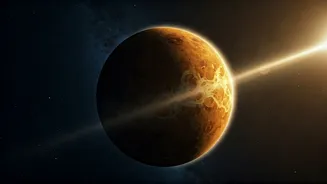
has a shorter journey. It zips around our star in just under 225 Earth days. So, if you were born on Venus, you'd celebrate a birthday every 225 days. Simple enough, right? This orbital period is the straightforward part of the equation. The real weirdness begins when we look at how Venus spins on its axis.
The Day That Lasts Forever
Now for the day. A 'day' on a planet is the time it takes to complete one full rotation on its own axis. Earth does this in about 24 hours. Venus, however, is the laziest spinner in the solar system. It rotates incredibly slowly, taking a staggering 243 Earth days to complete just one turn. So, a single rotation of Venus (243 days) is significantly longer than its entire orbit around the Sun (225 days). This is the core of the paradox: one Venusian 'sidereal day' (a full 360-degree rotation) is longer than one Venusian year. It’s the only planet in our solar system where this is the case. But the story gets even stranger.
The Planet That Spins Backwards
Not only does Venus spin slowly, it also spins backwards. Nearly every other planet, including Earth, rotates counter-clockwise on its axis. Venus spins clockwise, a phenomenon known as retrograde rotation. This has a bizarre effect on its 'solar day'—the time from one sunrise to the next. Because the planet is rotating backwards as it orbits the Sun, the time between sunrises is actually shorter than its rotational period. The combination of its slow spin and backward motion means a solar day on Venus lasts about 117 Earth days. So, you'd experience roughly 58 days of continuous daylight followed by 58 days of unending night. And you'd only see two sunrises for every one trip you made around the Sun.
Why Is Venus So Weird?
Scientists don't have a single, definitive answer for Venus's strange rotation, but there are two leading theories. One popular hypothesis suggests that Venus was struck by a massive asteroid or protoplanet early in its history. Such a cataclysmic impact could have been powerful enough to not just slow its rotation to a crawl but actually reverse its direction entirely. Another compelling theory points to Venus's incredibly thick and heavy atmosphere—about 90 times denser than Earth's. Scientists believe that powerful atmospheric tides, created by solar heating, could have acted as a powerful brake over billions of years, slowing the planet's spin and eventually locking it into its current, lazy, retrograde state. It's possible a combination of both factors contributed to making Venus the oddball of the solar system.
What a 'Day' on Venus Would Be Like
Forget setting your watch. Experiencing a day on Venus would be a hellish ordeal. The sun would rise in the west and set in the east, moving across the sky at an almost imperceptible pace. For nearly two straight months, the surface would bake under relentless sunlight, with temperatures soaring to 475°C—hot enough to melt lead. This heat is trapped by a dense blanket of carbon dioxide and sulfuric acid clouds, creating a runaway greenhouse effect. Then, for the next two months of darkness, the temperature would barely drop. The atmospheric pressure at the surface is over 90 times that of Earth's, equivalent to being nearly a kilometre deep in the ocean. It's a world of extremes, where the concepts of day and night are stretched to almost unimaginable lengths.