





First, What Is a Super-Earth?
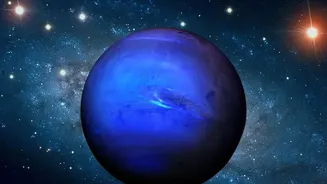
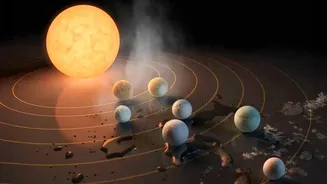
Before diving into the ‘how’, it’s important to understand the ‘where’. Super-Earths are a class of exoplanets—planets outside our solar system—unlike anything we have locally. They are more massive than Earth but lighter than our ice giants like Neptune.
This means they can have a radius up to about two and a half times that of Earth and a mass up to ten times greater. Intriguingly, while super-Earths are one of the most common types of planets discovered in our galaxy so far, our own solar system doesn't have one. These worlds can be rocky, gaseous, or a combination, and scientists are particularly interested in them because their size and stronger gravity could make them more likely to retain a substantial atmosphere, a key prerequisite for hosting liquid water and, potentially, life.
The Magic of Infrared Light
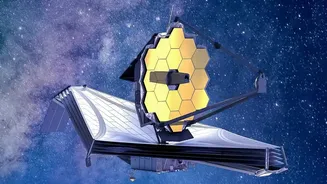
The key to JWST’s detection ability is its focus on infrared light. While the Hubble Space Telescope primarily observes the universe in visible and ultraviolet light, JWST is designed to see in infrared. This is crucial for two reasons. First, infrared light can penetrate the vast clouds of cosmic gas and dust that might otherwise obscure a distant planet. Second, and most importantly for finding water, different gas molecules in a planet's atmosphere absorb specific wavelengths (or colours) of light. Water vapour, methane, and carbon dioxide each have a unique absorption 'fingerprint' in the infrared part of the spectrum. So, by looking in infrared, JWST can see the chemical signatures that are invisible to the naked eye.
The Technique: Transmission Spectroscopy
The primary method JWST uses is called transmission spectroscopy. The process is conceptually simple but technically brilliant. It works when an exoplanet passes in front of its host star from our point of view—an event called a 'transit'. As the planet transits, a tiny fraction of the starlight filters through the planet's atmosphere. The gases present in that atmosphere absorb some of that starlight at very specific infrared wavelengths. The light that finally reaches the telescope has a 'barcode' of missing colours. By analysing this barcode, or spectrum, astronomers can determine precisely which gases are present. In effect, the star acts as a giant backlight, illuminating the planet’s atmospheric composition for JWST to read.
JWST's Specialized Toolkit
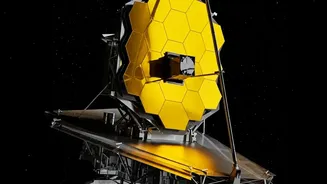
To perform this delicate analysis, JWST is equipped with a suite of powerful instruments. The Near-Infrared Spectrograph (NIRSpec) and the Near-Infrared Imager and Slitless Spectrograph (NIRISS) are two of the main tools for the job. These instruments act like incredibly sophisticated prisms, taking the faint light that has passed through an exoplanet's atmosphere and spreading it out into its full spectrum—a rainbow of over 2,000 infrared shades. When scientists see dips in the brightness of specific shades, they can match those dips to the known absorption patterns of molecules like water. The level of detail is unprecedented, allowing for the detection of even trace amounts of gases hundreds of light-years away.
A Real-World Example: K2-18 b
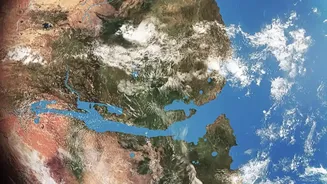
This technology isn't just theoretical; it's already delivering stunning results. A prime example is the super-Earth K2-18 b, located about 124 light-years away. Orbiting its star within the 'habitable zone'—the region where temperatures could allow for liquid water—this planet became a top target for JWST. While the Hubble telescope first hinted at water vapour in its atmosphere, JWST's more powerful infrared observations confirmed the presence of water vapour and also detected methane and carbon dioxide. This combination of molecules supports the theory that K2-18 b could be a 'Hycean' world—a planet with a water ocean under a hydrogen-rich atmosphere. There was even a controversial and unconfirmed detection of dimethyl sulfide, a compound on Earth primarily produced by marine life.
Why Finding Water Vapour Matters
Detecting water vapour is not the same as finding an ocean, let alone life. The signal could originate from a steamy, uninhabitable atmosphere, or in some cases, even from cool spots on the host star itself. However, the presence of water is a critical first step. It is the solvent for life as we know it, and identifying planets with water helps scientists narrow down the search. These discoveries allow astronomers to prioritise the most promising candidates for even deeper observation. Each detection is another piece of the puzzle, helping to build a more complete picture of a distant world and informing the bigger question of whether it could harbour a habitable environment.