






What Exactly Is Ring Rain?
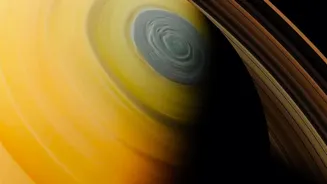
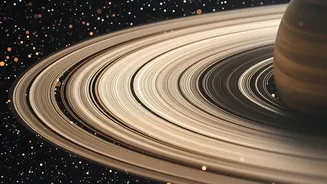
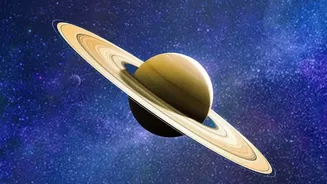
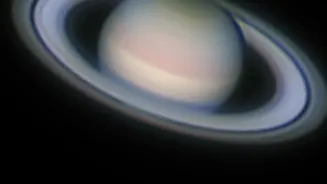
Imagine a constant, invisible shower falling from the sky, but instead of water, it's made of microscopic ice and dust particles. This is what's happening on Saturn. 'Ring rain' is the term scientists use to describe material from Saturn's rings being
pulled inwards by the planet's immense gravity and along its magnetic field lines, eventually falling into the upper atmosphere. For years, researchers knew this process occurred, but data from NASA's Cassini spacecraft revealed it was happening at a much faster rate than previously imagined—more of a downpour than a drizzle. The sheer volume of this cosmic rain is staggering, with estimates suggesting that material equivalent to an Olympic-sized swimming pool falls onto the planet every half-hour.
The Science Behind the Cosmic Downpour
The mechanics of ring rain are a complex interplay of forces. Saturn's rings are primarily composed of countless chunks of water ice, ranging in size from tiny dust grains to massive boulders. These particles are in a delicate balance between their orbital speed, which wants to fling them outwards, and Saturn's gravity, which wants to pull them in. However, external forces can disrupt this balance. Ultraviolet light from the sun and micrometeoroid impacts can give the tiny ice particles an electrical charge. Once charged, they become susceptible to Saturn's magnetic field, which acts like a giant conveyor belt, guiding these particles down into the planet's atmosphere. This influx of material, mostly water but also containing organic compounds like butane and propane, then heats up and chemically reacts with Saturn's ionosphere.
A Fleeting Celestial Wonder
The discovery of this intense ring rain has led to a profound realisation: Saturn's rings are a temporary feature. By measuring the rate of material falling into the planet, scientists have been able to estimate the remaining lifespan of this iconic system. Current estimates, based on data from the Voyager and Cassini missions, suggest the entire ring system could be gone in as little as 100 million years, and will certainly disappear within 300 million years. While this may sound like a long time in human terms, it's a very short period on a cosmic scale, especially considering Saturn itself is over 4.5 billion years old. This also suggests the rings are relatively young, likely forming no more than 100 million years ago, possibly from the debris of a shattered moon.
How Scientists Confirmed the Rain
The theory of ring rain dates back to the 1980s when NASA's Voyager spacecraft spotted dark bands in Saturn's atmosphere, which scientists theorised could be caused by water falling from the rings. However, direct evidence remained elusive for decades. The breakthrough came from NASA's Cassini mission, particularly during its 'Grand Finale' in 2017. In its final orbits, the spacecraft flew through the gap between Saturn and its rings, directly sampling the particles falling into the planet. Its instruments measured a surprising mix of water, molecular hydrogen, and complex organic molecules, confirming the composition of the rain. Further evidence comes from observations of Saturn's upper atmosphere, which shows an unusual excess of ultraviolet radiation—a telltale sign of heating caused by external particles raining down.
The Impact on Saturn's Atmosphere
This constant downpour has a significant impact on Saturn itself. The influx of water particles influences the composition and temperature of the planet's upper atmosphere. One of the key effects is the 'quenching' of Saturn's ionosphere. The falling water reacts with and neutralises electrically charged particles in the atmosphere, leading to a noticeable reduction in electron densities in the regions where the rain is heaviest. This explains long-standing anomalies that scientists had observed for decades. Essentially, the planet's most famous external feature is actively shaping its atmospheric climate and chemistry from thousands of kilometres above the cloud tops.