




A Journey to the Frontier
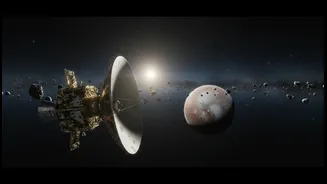
For many, the story of New Horizons peaked on July 14, 2015. After a journey of nearly a decade, the spacecraft flew past Pluto, transforming it from a distant, blurry dot into a stunningly complex world. The images sent back were breathtaking, revealing
jagged mountains of water ice, vast nitrogen glaciers, and hints of a subsurface ocean. It showed us a dynamic, geologically active dwarf planet at the edge of our solar system, completely upending theories that it would be a simple, frozen rock. That flyby alone secured New Horizons’ place in history, but its mission was far from over. It was always designed not just to visit Pluto, but to be the first dedicated explorer of a region we barely knew existed: the Kuiper Belt.
Life Beyond Pluto
After its Pluto triumph, New Horizons was given a new target. On New Year's Day 2019, it performed a flawless flyby of Arrokoth, the most distant object ever explored by a spacecraft. Arrokoth looked like a cosmic snowman, two pristine, icy bodies gently fused together. This wasn’t just a curiosity; it was a profound clue about the birth of planets. Scientists believe this is how planetesimals—the building blocks of planets—formed in the early solar system, not through violent collisions but through gentle accumulation. Arrokoth was a perfectly preserved relic from over 4.5 billion years ago. By studying it, New Horizons gave us a direct look at the conditions that prevailed when our solar system was just beginning to take shape.
A Lonely Watch in the Dark
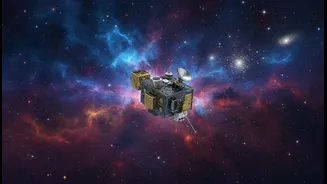
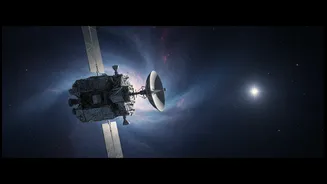
Today, New Horizons continues its journey through the vast, dark expanse of the Kuiper Belt. In early July 2026, the spacecraft successfully woke from a 321-day hibernation, its longest sleep yet. This power-saving measure is crucial for a mission so far from the sun, but it doesn't mean the probe is idle. Even while hibernating, its instruments continue to collect valuable data on the solar wind, energetic particles, and space dust, acting as a lonely sentinel in the outer solar system. Now awake, it will begin the slow process of transmitting that data back to Earth—a process complicated by a communication lag of nearly nine hours each way. Its next task involves using its ultraviolet spectrograph to study the distribution of hydrogen gas at the solar system's edge, science that is only possible from its unique vantage point.
Standing on the Shoulders of Giants
The story of New Horizons is deeply connected to its predecessors, NASA’s Voyager 1 and 2 probes. Launched in 1977, the Voyagers are the definition of ageing explorers. They completed their grand tour of the outer planets decades ago and are now the only human-made objects to have entered interstellar space. Though their power is dwindling, they still send back data about the environment beyond our sun’s protective bubble, the heliosphere. New Horizons is following in their path. Expected to cross into interstellar space around 2028 or 2029, it carries much more advanced and sensitive instruments than the Voyagers. It will be able to build on the Voyagers' pioneering discoveries, giving us a far more detailed picture of the boundary where our solar system meets the rest of the galaxy.
The Enduring Value of Patience
What New Horizons and the Voyagers prove is that the value of a deep-space mission extends far beyond its primary objective. They are not just sprinters sent to a single destination; they are marathon runners, providing a constant stream of data from regions we cannot otherwise study. They act as our most distant outposts, measuring the environment of deep space in real time. The Kuiper Belt, which New Horizons is currently exploring, is a vast repository of pristine material left over from the formation of our solar system. Studying these objects tells us not only about our own history but provides a framework for understanding the thousands of other planetary systems we now know exist in the galaxy.