


The Awakening: What Makes a Black Hole 'Active'?
Most large galaxies, including our own Milky Way, have a supermassive black hole at their center. For most of their lives, these giants are dormant and invisible. A black hole becomes 'active' when a supply of gas, dust, or an unlucky star wanders too
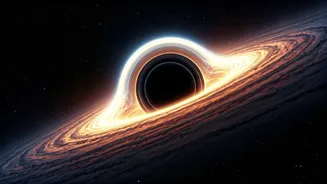
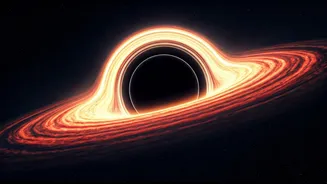
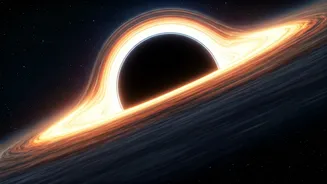
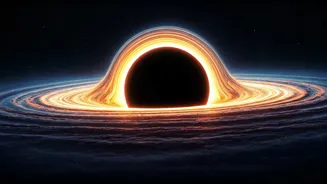
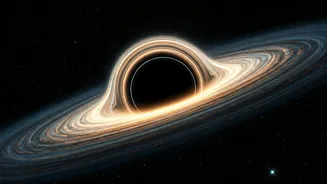
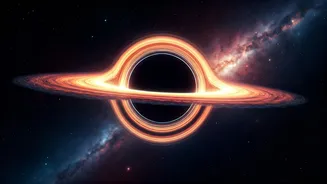
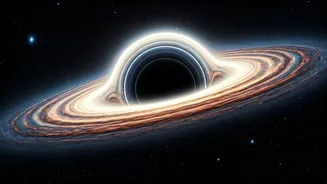
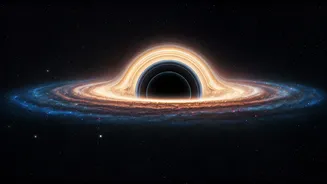
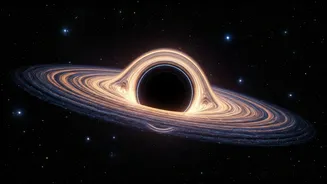
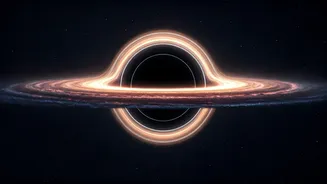
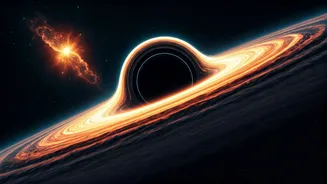
close. Drawn in by immense gravity, this material doesn't fall straight in. Instead, it forms a swirling, superheated whirlpool called an accretion disk. The friction and intense gravitational forces in this disk cause it to glow brilliantly across the electromagnetic spectrum, from X-rays to radio waves, turning the black hole from a silent lurker into a luminous Active Galactic Nucleus (AGN) or quasar. This sudden burst of activity is the moment the black hole wakes up and begins to profoundly influence its surroundings.
A Zone of Utter Destruction
The immediate vicinity of a newly active black hole is one of the most violent places in the universe. For a star or star cluster, a close pass is catastrophic. The black hole's immense gravity exerts a stronger pull on the near side of an object than the far side. This difference, known as a tidal force, can stretch and rip a star apart in an event called a tidal disruption event (TDE). About half of the star's shredded material is flung away at high speeds, while the other half is captured by the black hole, feeding the brilliant accretion disk. This process is not a gentle nibble; it's a messy, explosive act that releases a tremendous flare of energy. For any star clusters nearby, the intense radiation from the accretion disk can heat and strip away their gas, fundamentally altering their structure.
Cosmic Blowtorches: Jets and Outflows
Not all the material caught by an active black hole is consumed. A significant portion is channeled by powerful magnetic fields and ejected away from the black hole's poles in two narrow, focused beams known as relativistic jets. Traveling at nearly the speed of light, these jets are cosmic blowtorches that can extend for hundreds of thousands of light-years, far beyond the confines of the host galaxy. In addition to these focused jets, broader, less powerful winds of hot gas are also blasted outwards from the accretion disk. Together, these jets and outflows act as a powerful feedback mechanism, carrying energy and matter from the immediate vicinity of the black hole out into the wider galaxy.
The Paradox of Star Formation
Here is where the black hole's impact becomes a fascinating paradox. These powerful outflows can be agents of both creation and destruction for star clusters. On one hand, the winds can slam into vast, cold clouds of molecular gas—the raw material for stars—and blow them away, effectively starving the region of fuel and shutting down star formation. This process is known as 'quenching' and is believed to play a crucial role in regulating a galaxy's growth. On the other hand, the shockwave from a jet or outflow can also compress the gas in these clouds, triggering a sudden, intense burst of new star formation. Astronomers have observed new, hot, bright stars forming directly within these outflows, proving that black holes can kickstart the birth of stars even as they quench it elsewhere.
A Galactic Thermostat
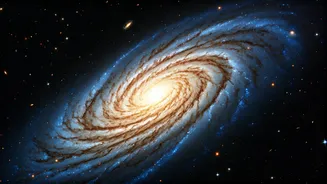
Ultimately, a newly active black hole acts like a galactic thermostat. Its activity provides a self-regulating feedback loop. When too much gas falls toward the galactic center, the black hole 'activates,' launching jets and winds that heat and expel the surrounding gas. This clears out the region, cutting off the black hole's own fuel supply and slowing down star formation throughout the galaxy. The black hole then becomes dormant again, allowing gas to cool and collect, eventually leading to a new cycle of star birth and, potentially, another active phase. This complex interplay between the central black hole and its surrounding star clusters is a fundamental process that shapes the long-term evolution, size, and appearance of entire galaxies. Studying these events helps us understand not just the life cycle of black holes, but the life cycle of the cosmos itself.