


A Panoramic View of the Universe
Imagine trying to study an entire forest by looking through a straw. For decades, telescopes like Hubble and Webb have given us breathtaking, deep views of tiny patches of the sky. They are masters of the close-up, studying individual trees with incredible
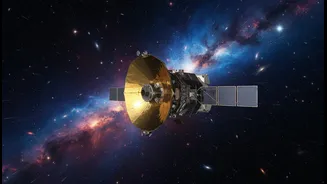
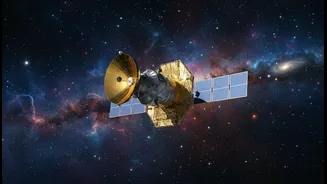
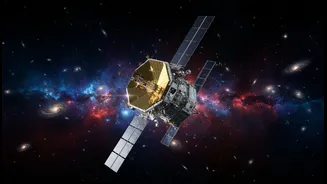
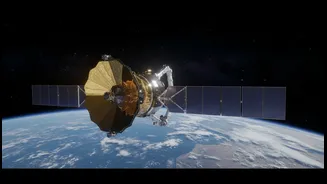
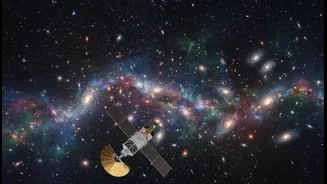
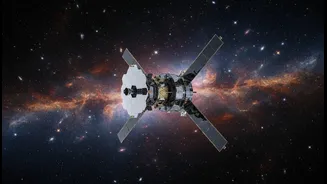
detail. The Nancy Grace Roman Space Telescope, scheduled to launch on a SpaceX Falcon Heavy rocket on August 30, 2026, is built to do the opposite. It is a survey telescope, designed to take in the whole forest. While its primary mirror is the same size as Hubble's at 2.4 meters, its Wide Field Instrument (WFI) is a 300-megapixel camera that gives it a field of view at least 100 times larger than Hubble's or Webb’s. In a single shot, Roman can capture a patch of sky larger than the full moon. This incredible survey power will allow it to map the sky up to 1,000 times faster than Hubble, creating the largest, most detailed cosmic maps ever made.
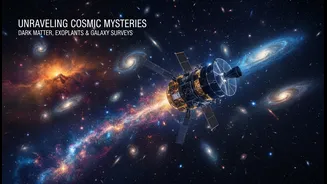
Unraveling Cosmic Mysteries
Roman's primary mission is to tackle two of the biggest questions in cosmology: dark energy and dark matter. Together, these mysterious phenomena make up about 95% of the universe, yet we know almost nothing about them. Dark energy is the force believed to be causing the expansion of the universe to accelerate. Roman will investigate it by surveying over a billion galaxies and thousands of exploding stars called Type Ia supernovae. By measuring how these objects are distributed and how their light has been stretched over cosmic history, scientists can create a 3D map of the universe and trace the influence of dark energy through time. It will also study dark matter by observing how its gravity bends the light from distant galaxies, a phenomenon called weak gravitational lensing. These massive surveys will provide unprecedented data to test theories about the fundamental nature of our universe.
A New Census of Alien Worlds
Beyond cosmology, Roman is poised to become a planet-hunting powerhouse. The mission is expected to discover thousands of exoplanets, worlds orbiting other stars. Its primary method will be gravitational microlensing. This technique observes the light from a distant star and looks for a temporary brightening that occurs when another star and its planets pass in front of it from our point of view. The gravity of the foreground planetary system acts like a lens, magnifying the light of the background star. This method is sensitive enough to find planets with masses similar to Earth's and even smaller, including rogue planets that drift through space without a host star. In addition, Roman will test a new technology called a coronagraph. This instrument is designed to block the overwhelming glare from a star, allowing for the direct imaging of planets orbiting it—a key step toward one day analyzing the atmospheres of Earth-like worlds.
A New Partnership in the Sky
Roman will not replace telescopes like Hubble and Webb, but rather work in concert with them. Its power lies in its ability to quickly scan enormous sections of the sky and identify targets of interest. Scientists anticipate Roman will find tens of thousands of new objects and cosmic events. Once Roman flags an intriguing galaxy, a strange supernova, or a promising planetary system, the more focused gaze of Webb or Hubble can be directed to study it in greater detail. This synergy will define the next era of astronomy, combining Roman's wide-angle survey capabilities with the deep-dive precision of other observatories. Roman will create the catalogue of the cosmos, while Webb and Hubble write the detailed biographies of its most fascinating inhabitants.