






The Universe's Missing Mass
Our understanding of the cosmos has a huge hole in it, and that hole is shaped like dark matter. Scientists are certain it exists because they can see its gravitational effects everywhere they look. It acts as an invisible 'cosmic glue' holding entire
galaxies together and bending the path of light across the universe. Without it, galaxies would fly apart, and the large-scale structures of the cosmos would never have formed. The problem is, dark matter doesn't seem to interact with light or any other form of radiation, making it completely invisible and undetectable by our conventional instruments. It accounts for roughly 27% of the universe's mass-energy budget, with ordinary matter (the stuff that makes up stars, planets, and us) accounting for a mere 5%. Despite knowing it's there, no particle in our current Standard Model of physics can explain what it is. This gap has sent physicists searching for 'new physics' beyond our current understanding.
Thinking Outside Our Four Dimensions
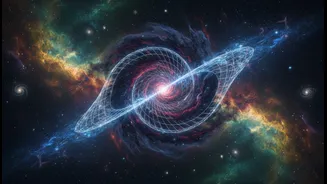
What if dark matter isn't a new particle in our familiar three dimensions of space and one of time, but something lurking just outside our perception? This is the core of a compelling new theory that ties the mystery of dark matter to the existence of a hidden fifth dimension. This idea builds on a concept known as the 'warped extra dimension' (WED) model, first proposed in 1999 by physicists Lisa Randall and Raman Sundrum. Their theory suggested the universe might have an extra, hidden spatial dimension that is 'warped' or curved. While we and most forces of nature are stuck to our 4D 'brane' (a slice of this higher-dimensional space), gravity might be able to leak into this fifth dimension. More recent studies, including one by scientists from Spain and Germany and another from the University of Sheffield, have extended this idea to explain dark matter itself.
Portals to a Dark Sector
So how does a fifth dimension create dark matter? One version of the theory proposes that certain fundamental particles, known as fermions, can travel through 'portals' into this warped extra dimension. Once these particles make the leap, they begin to exist within this hidden space, creating what physicists call a 'dark sector'. From our perspective on the 4D brane, we can no longer 'see' these particles through the electromagnetic or nuclear forces. However, we can still feel their gravitational pull as it extends from the fifth dimension back into ours. In this view, dark matter isn't some exotic, undiscovered particle; it might be created by familiar particles behaving in a new way in a dimension we cannot access. It elegantly explains why dark matter has mass and gravity but remains invisible.
A Natural Resonance
A related theory from the University of Sheffield adds another layer, suggesting dark matter exists in this hidden dimension alongside a 'dark photon'. According to their research, the specific geometry of the fifth dimension could cause the properties of these particles to naturally align in a special way, creating a 'dark matter resonance'. This resonance is similar to how a musical instrument vibrates intensely at a specific note. This could explain a key puzzle: why dark matter seems to have interacted more strongly in the early universe but is so inert and hard to detect today. In the past, this resonance would have been active, allowing for its creation, but now it lies dormant. Crucially, this model proposes that this 'perfect tuning' isn't a coincidence that needs to be artificially inserted into the physics, but a natural outcome of the hidden dimension's structure.
Searching for a Hidden Reality
While fascinating, these ideas are still theoretical. The challenge, as always, is finding evidence. How do you prove a dimension you can't see? The answer might lie in gravity itself. According to proponents of these theories, the existence of a fifth dimension and the particles within it could generate faint but unique gravitational waves. Future gravitational wave detectors, more powerful and sensitive than our current ones, might be able to pick up these tell-tale ripples from a hidden dimension. Additionally, while current particle accelerators like the Large Hadron Collider may not have the power to create the 'portal' particle needed to access the fifth dimension, its existence provides new targets for physicists to aim for in future experiments. These theories provide clear, testable new directions in the hunt for one of the universe's most profound secrets.