

India's Next Interplanetary Leap: Shukrayaan
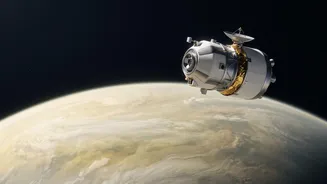
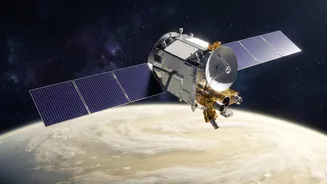
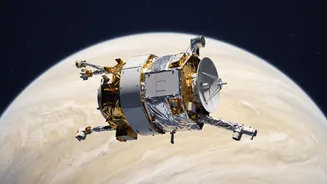
Building on the monumental successes of the Chandrayaan missions to the Moon and the Mangalyaan mission to Mars, ISRO is venturing towards the second planet from the Sun. The mission, officially named the Venus Orbiter Mission (VOM) but popularly known
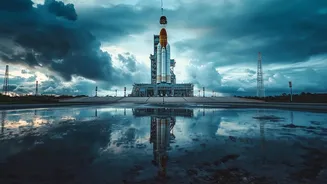
as Shukrayaan (meaning 'Venus Craft' in Sanskrit), represents India's first dedicated mission to our so-called 'twin' planet. Formally approved in September 2024, the mission is currently planned for a March 2028 launch aboard India's most powerful rocket, the LVM-3. This endeavour is not just another feather in ISRO's cap; it's a critical step in a global scientific effort to understand why a planet so similar to Earth in size and origin evolved into a scorching, inhospitable world.
The Scientific Toolkit for a Toxic World
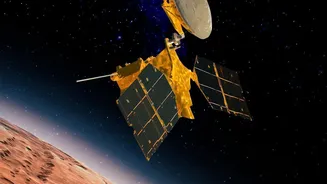
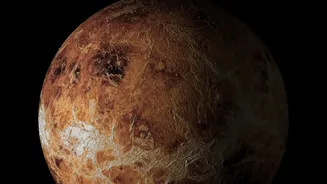
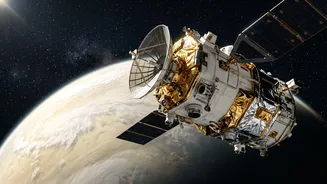
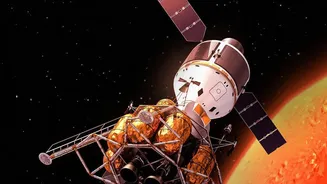
To peer through Venus's thick, corrosive veil, Shukrayaan will carry a payload of approximately 100 kg of advanced scientific instruments. A key instrument will be a high-resolution Synthetic Aperture Radar (SAR), capable of piercing the dense cloud cover to map the planet's surface in unprecedented detail. This will be complemented by a ground-penetrating radar to investigate the shallow subsurface, a first for any Venus mission. For the atmospheric study at the heart of the mission, the orbiter will be equipped with a suite of high-precision sensors, including infrared and ultraviolet cameras and spectrometers. These instruments, some developed with international partners from Russia, France, and Sweden, will analyse the composition and dynamics of the atmosphere, measuring gases and searching for clues about ongoing geological activity like volcanism.
Unraveling the Mysteries of Earth's 'Evil Twin'
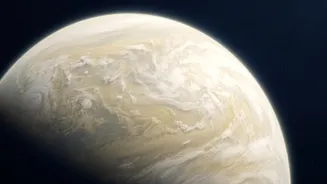
Venus is often called Earth's twin due to its similar size and mass, but the resemblance ends there. It is the hottest planet in our solar system, with a surface temperature that can melt lead and a crushing atmospheric pressure over 90 times that of Earth's. Its sky is filled with thick clouds of sulfuric acid instead of water. Scientists believe Venus may have once been more like Earth, possibly with liquid water, but suffered a runaway greenhouse effect. Studying this process provides a cautionary tale and a natural laboratory for understanding climate change on our own planet. The Shukrayaan mission aims to tackle key questions: What drives the mysterious 'super-rotation' of its atmosphere? What can its surface and subsurface geology tell us about its volcanic history? And could there be, as some tantalizing but debated findings have suggested, chemical traces of microbial life high in its more temperate cloud layers?
A Landmark for Indian Science and Technology
Developing and deploying these complex sensors highlights India's growing self-reliance and technological prowess in the competitive field of space exploration. The mission will also see ISRO employ advanced techniques for the first time, such as aerobraking. This maneuver involves using the friction of Venus's upper atmosphere to gradually adjust the spacecraft's orbit, conserving precious fuel and allowing for a longer mission duration. The scientific data gathered will be invaluable, positioning India as a key contributor to planetary science. More than that, missions like Shukrayaan serve as a powerful inspiration, demonstrating the nation's scientific ambitions and encouraging a new generation to pursue careers in science, technology, engineering, and mathematics. As ISRO methodically prepares for this challenging mission, it reinforces India's status as a major spacefaring nation with its sights set firmly on the deepest questions of our solar system.