




What is Space Weather?
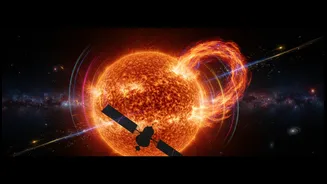
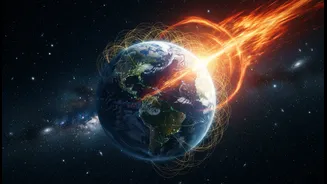
Space weather refers to the changing conditions in space driven by the Sun's activity. The main culprits are solar flares and coronal mass ejections (CMEs). A solar flare is an intense burst of radiation from the Sun's surface, releasing energy equivalent
to a billion hydrogen bombs. CMEs, on the other hand, are massive eruptions of plasma and magnetic fields from the Sun's outer atmosphere, the corona. While flares release radiation that can reach Earth in minutes, CMEs are clouds of matter that travel slower, taking one to three days to arrive. When these events are directed at our planet, they interact with Earth's protective magnetic field and can cause significant disruptions to our technology-dependent society.
The Power Grid at Risk
One of the most significant terrestrial threats from space weather is to our electrical power grids. A powerful CME can induce strong electrical currents on the Earth's surface, known as geomagnetically induced currents (GICs). These currents can flow into long conductors like power lines and pipelines. When GICs enter high-voltage transformers—the backbone of any power grid—they can cause the transformers' magnetic cores to saturate, leading to overheating, damage, and even complete failure. This isn't just a theoretical risk. In 1989, a geomagnetic storm caused a widespread blackout across Quebec, Canada, leaving millions without power for hours. More recent events have caused transformer damage and grid instability in other parts of the world, highlighting the vulnerability of our interconnected electrical systems.
Your GPS Could Go Haywire
Our reliance on the Global Positioning System (GPS) has become absolute, from navigating with maps on our phones to complex operations in aviation, shipping, and farming. Space weather directly impacts GPS accuracy. The signals from GPS satellites must travel through the Earth’s ionosphere, an upper layer of the atmosphere. Radiation from solar flares can alter this layer, delaying or distorting the GPS signal. This can result in navigation errors ranging from a few metres to a complete loss of signal. For industries that rely on precision location services, like aviation landings or modern farming equipment, even small errors can have major consequences. During severe solar storms in 2003, a system that augments GPS for aircraft was rendered unavailable for about 30 hours.
Disruptions in Aviation and Communication
The aviation industry pays close attention to space weather forecasts. Severe solar events can disrupt high-frequency (HF) radio communications, which are crucial for pilots, especially on transpolar routes where satellite communication is limited. This can sometimes force flights to be rerouted. Beyond communication, there's a risk of increased radiation exposure for crew and passengers on high-altitude flights during a major solar storm. The same solar radiation that affects the ionosphere for GPS also causes radio blackouts on the sunlit side of the Earth, impacting not just aviation but also military and emergency communications.
India’s Watchful Eye from Space
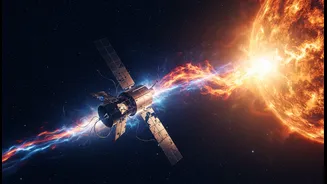
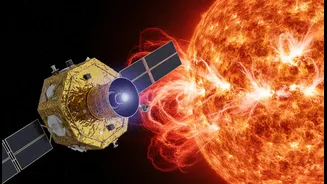
Recognising these risks, nations are investing in better space weather monitoring, and India is a key player. The Indian Space Research Organisation (ISRO) launched the Aditya-L1 mission, the country's first dedicated solar observatory. Positioned at a unique vantage point 1.5 million kilometres from Earth, Aditya-L1 has an uninterrupted view of the Sun. Its suite of seven instruments observes solar flares and CMEs and measures the solar wind, functioning as an advanced space weather station. Data from Aditya-L1 helps scientists understand solar dynamics and provides crucial early warnings about Earth-directed storms, allowing for better protection of our critical infrastructure on the ground and assets in space.