




Your Pocket Planetarium
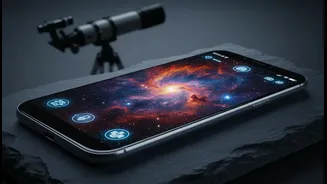
The single biggest change in amateur astronomy is the rise of sophisticated planetarium apps. Before smartphones, identifying a bright object in the night sky required star charts, planispheres, and a good deal of guesswork. Now, apps like Stellarium
Mobile, SkyView, and Star Walk 2 use your phone's GPS and compass to create a real-time map of the sky. Simply point your phone upwards, and the screen will display an augmented reality overlay, naming the stars, constellations, and planets you're looking at. These apps can show you where to find everything from the International Space Station to distant galaxies. Many also include calendars for celestial events like meteor showers and eclipses, ensuring you never miss a moment. Some, like SkySafari 7 Pro, even have databases with millions of celestial objects.
The Rise of Mobile Astrophotography
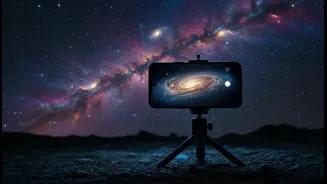
Not long ago, capturing a decent photo of the moon with a phone was a blurry, disappointing affair. But as smartphone cameras have become remarkably powerful, a new field has emerged: mobile astrophotography. Modern phones with advanced 'Night Sight' or 'Night Mode' features, like Google's Pixel series, use computational photography to stack multiple long-exposure shots, drastically reducing noise and revealing faint stars. To get started, all you really need is a dark sky location, away from city light pollution, and a small, sturdy tripod to keep your phone perfectly still during the exposure. Apps like NightCap for iOS or Android apps that allow manual control over ISO and shutter speed give you the DSLR-like controls needed to capture stunning images of constellations, star trails, and even the Milky Way.
Bridging the Gap with Smart Accessories
While a phone on a tripod can do wonders, the next level involves pairing it with a traditional telescope. This is where a new generation of affordable accessories comes in. A simple smartphone adapter is a clamp that holds your phone's camera lens perfectly aligned with a telescope's eyepiece. This technique, known as afocal photography, effectively turns your phone into a high-powered camera, allowing you to capture detailed images of the moon's craters or the rings of Saturn. Companies like Celestron offer adapters with geared knobs that make the alignment process simple and precise. Other innovations, like the Hestia device, are compact, lens-based systems designed specifically to gather light and channel it directly into your phone's camera, transforming it into a smart telescope.
Contributing to Real Science
The mobile astronomy revolution isn't just about personal enjoyment; it's also empowering a new wave of citizen scientists. Your smartphone can be a tool for genuine scientific research. NASA's GLOBE Observer app allows users to submit observations about clouds, which helps scientists understand Earth's climate. Other projects, like NASA's Meteor Counter, let you contribute to research by recording data on meteors during a shower. Historically, scientists have relied on a limited number of observatories. By networking thousands of smartphones, projects like CRAYFIS aim to create a planet-sized detector to study cosmic rays—high-energy particles from space that are difficult to track. These initiatives turn a personal hobby into a collaborative scientific endeavour.