



Waves: Energy from the Wind
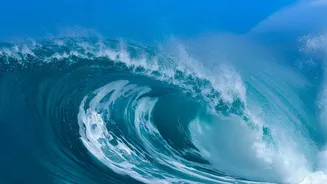
Most of the waves you see at the beach are created by the wind. As wind blows across the ocean's surface, friction transfers energy from the air to the water, creating ripples. If the wind is strong and persistent, these ripples grow into the familiar
crests and troughs we call waves. It’s a common misconception that the water itself is travelling across the ocean. In reality, a wave is energy passing through the water, causing water particles to move in a circular motion. The water itself doesn't move horizontally over long distances, but the energy does. The size of a wind-driven wave depends on the wind's speed, how long it blows, and the distance over which it has contact with the water. This is why a gentle breeze on a lake creates small ripples, while a storm far out at sea can generate massive swells that travel for thousands of kilometres.
Tides: The Pull of the Cosmos
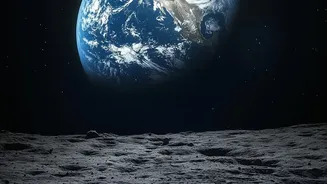
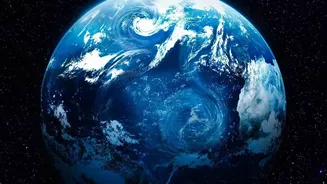
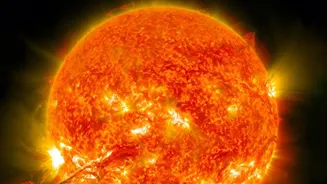
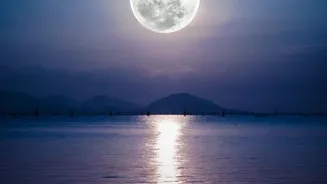
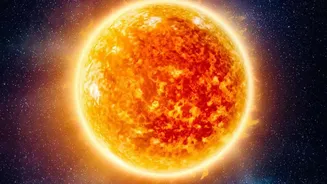
Tides, on the other hand, are caused by the immense gravitational pull of the Moon and, to a lesser degree, the Sun. As the Moon orbits Earth, its gravity tugs on our planet. This pull is strong enough to create bulges in the ocean water on both the side of Earth closest to the Moon and the side farthest away. These bulges are the high tides. As the Earth rotates on its axis, a coastal location passes through these two bulges each day, resulting in two high tides and two low tides approximately every 24 hours and 50 minutes. Unlike the relatively quick and chaotic energy of waves, tides are a slow, predictable, and powerful rise and fall of the entire sea level.
A Question of Scale and Period
The most striking difference between waves and tides is their scale. A typical ocean wave might have a wavelength—the distance from one crest to the next—of a few metres. Its period, the time it takes for two successive crests to pass a point, is just a few seconds. In contrast, a tide is a wave of planetary proportions. Its wavelength can be thousands of kilometres long, literally half the circumference of the Earth. Its period isn't measured in seconds, but in hours—roughly 12 hours and 25 minutes between one high tide and the next. So, while you can watch dozens of waves crash in a minute, you only experience two full tidal cycles in a day.
An Analogy: The Ripple and the Tilt
To put it simply, imagine a bathtub. If you blow across the surface of the water, you create small waves—ripples of energy moving across the top. This is analogous to how wind creates ocean waves. Now, imagine you slowly and gently tilt the entire bathtub from one side to the other. The water level on one end rises while the other end falls. This is what tides do to the entire ocean basin. Waves are a surface-level disturbance, while tides are the slow, deliberate sloshing of the whole body of water, dictated by celestial forces far beyond our planet.
What About 'Tidal Waves'?
The term 'tidal wave' is often used incorrectly to describe a tsunami. True tidal waves are just the tides themselves—the slow, predictable waves caused by gravity. Tsunamis, however, are a completely different and far more dangerous phenomenon. They are not caused by tides or wind, but by the sudden displacement of a massive volume of water, usually from an underwater earthquake, volcanic eruption, or landslide. These events create a series of extremely powerful waves that can travel across entire oceans and cause catastrophic damage when they reach land. While a tsunami can occur during any tidal state, its cause is entirely separate from the gravitational pull of the Moon and Sun.