







The Enduring Mystery of the Northern Hexagon
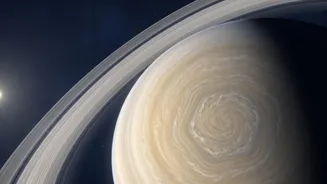
For over forty years, since it was first spotted by the Voyager spacecraft in the 1980s, Saturn's north pole has been home to one of the solar system's most peculiar features: a six-sided jet stream known as the hexagon. This isn't just a vague shape;
it's a remarkably stable and symmetrical weather pattern with sides longer than the diameter of Earth itself. The entire structure, about 32,000 kilometres across, rotates almost perfectly in sync with the planet. Scientists believe it is a type of standing wave in the atmosphere, a phenomenon that can be recreated in laboratory experiments with spinning fluids. Yet, its incredible persistence and perfect geometry have made it seem like a one-of-a-kind oddity in our celestial neighbourhood. For decades, researchers searched for a southern counterpart, but none was found, adding to the hexagon's mystique.
A New Shape Appears: The Southern Decagon
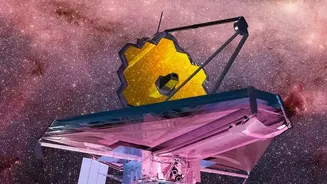
The celestial mystery has deepened with a recent discovery at the opposite pole. Astronomers using the Hubble Space Telescope have confirmed the existence of a new, ten-sided polygon—a decagon—swirling around Saturn’s south pole. This massive atmospheric wave was first hinted at in observations by amateur astronomers in 2024 before being confirmed by Hubble data. Part of the reason it was only just found is due to planetary mechanics; Saturn's axial tilt kept its south pole largely hidden from Earth’s view between 2012 and 2023. NASA’s Cassini spacecraft, which orbited Saturn until 2017, saw no such long-lived structure during its mission, indicating that the decagon is a relatively new and evolving phenomenon.
Hexagon vs. Decagon: A Tale of Two Storms
While both are geometric storms, the northern hexagon and the southern decagon are far from identical twins. The most obvious difference is their shape: six sides versus ten. This distinction is crucial, as the number of sides in such a wave is related to the specific speed and properties of the jet stream that contains it. The southern decagon is also significantly larger than its northern counterpart, measuring a colossal 167,000 kilometres across. In fact, each of its ten sides is long enough for the entire planet Earth to pass through. Perhaps the most significant difference is their lifespan. The hexagon has been a steady, persistent feature for at least four decades, while the decagon appears to be a new development that is currently strengthening and taking shape. This gives scientists a rare opportunity to watch a giant planetary weather pattern form in real-time.
The Science of Celestial Geometry
So, why does Saturn’s atmosphere create these bizarre shapes? The answer lies in fluid dynamics on a planetary scale. The polygons are believed to be a form of Rossby wave, which are giant meanders in high-speed jet streams. On a gas giant like Saturn, which has no solid surface of mountains or oceans to disrupt airflow, these jet streams can settle into highly regular and symmetrical patterns. Think of it like a river flowing smoothly until it hits a specific obstacle that creates a repeating wave pattern. On Saturn, the 'obstacles' are layers of atmosphere moving at different speeds. The discovery of a decagon proves that the hexagon isn't a fluke. Instead, it suggests that forming polygons is a fundamental behaviour of Saturn's atmosphere, given the right conditions. What those exact conditions are, and why one pole formed six sides while the other formed ten, are now the next big questions for planetary scientists to solve.