




The Cosmic Detective's Toolkit
So, what is infrared spectroscopy? Think of it as a cosmic version of a barcode scanner. Every atom and molecule absorbs and emits light in a unique pattern of colors, or wavelengths. Many of these tell-tale signatures, especially for molecules crucial
for life like water, methane, and carbon dioxide, appear in the infrared part of the light spectrum, which is invisible to human eyes. Infrared spectroscopy allows scientists to capture this light and spread it out like a rainbow, revealing these chemical 'barcodes'. By seeing which colors are missing or enhanced, we can deduce exactly what a distant object is made of.
How to Read an Alien Sky
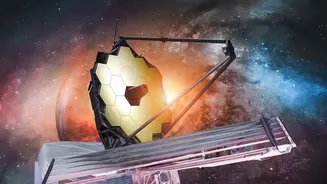
To study an exoplanet's atmosphere, astronomers use a clever technique called transmission spectroscopy. They wait for a planet to pass in front of its star, an event called a transit. As the starlight streams towards us, a tiny fraction of it filters through the planet's thin atmospheric halo. Molecules in that atmosphere absorb specific wavelengths of the starlight. Here on Earth, powerful instruments like those on the James Webb Space Telescope (JWST) can detect these minuscule dips in light. By comparing the starlight before and during the transit, scientists can subtract the difference to isolate the 'fingerprint' of the planet's atmosphere and determine its chemical makeup.
From Theory to Tantalizing Clues
This technology has moved from theory to incredible practice. The JWST has already provided unprecedented insights. For instance, while initial observations of planets in the famous TRAPPIST-1 system have been challenging, they have allowed scientists to rule out certain types of atmospheres. For TRAPPIST-1 e, a world in the habitable zone, data has suggested it's unlikely to have a thick, carbon dioxide-heavy atmosphere like Venus or Mars. More recently, in July 2026, astronomers announced the strongest evidence yet for an atmosphere on a rocky, habitable-zone exoplanet called LHS 1140 b, detecting helium escaping from its upper layers. These findings, even when inconclusive, are revolutionary, helping astronomers narrow down the possibilities of what these worlds are truly like.
The Search for Signs of Life
The ultimate goal, for many, is to find biosignatures—gases that indicate the presence of life. On Earth, life produces a mix of gases like oxygen, ozone, and methane. Detecting a single one isn't enough, as non-biological processes can also create them. For instance, methane can come from volcanoes, and oxygen can be produced abiotically. Scientists are therefore looking for a specific, unbalanced mix of gases that is hard to explain without biology. For example, detecting both methane and carbon dioxide in an atmosphere with very little carbon monoxide could be a strong hint of life. We are not there yet, and current results often lead to multiple interpretations, but every observation sharpens our focus.
A New Era of Exploration
The ability to detect any atmosphere on a rocky world is a monumental achievement. For years, theory predicted that many small planets, especially those orbiting close to their stars, might have their atmospheres stripped away entirely. Yet, recent findings, like the potential atmosphere on the ultra-hot super-Earth TOI-561 b, are challenging these assumptions. This planet is so hot it is thought to be covered by a magma ocean, yet it appears to have a blanket of gases. Each detection, whether of a thick atmosphere or a bare rock, provides crucial data points. This information helps scientists refine their models of how planets form, evolve, and whether they might, just possibly, harbor life.