


Piercing the Cosmic Dust Veil
For decades, some of the universe’s most dramatic secrets were hidden behind impenetrable walls of cosmic dust. Telescopes that see in visible light, like Hubble, were often blinded by these thick clouds. But with the infrared vision of the James Webb
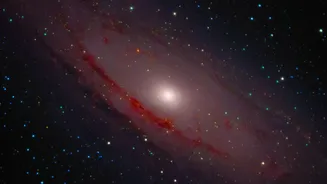
Space Telescope (JWST), astronomers can now peer through the dust and see what lies beneath. A stunning new look at Centaurus A, a galaxy just 11 million light-years away, shows this power in action. Where previous images showed a bright blob obscured by a dark dust lane, JWST reveals a breathtaking tapestry of millions of individual stars. More intriguingly, it has uncovered bizarre, hidden structures within the galaxy's core, including a warped, parallelogram-shaped disk of gas and dust and a mysterious S-shaped feature that has scientists puzzled. These details are fresh clues about the galaxy’s violent past, which involved a collision with another galaxy billions of years ago.
Rewriting the Universe's First Chapter
Perhaps the most startling revelations are coming from the edge of the observable universe. JWST was built to find the very first galaxies, but what it’s finding is forcing a major rewrite of cosmic history. Astronomers are spotting galaxies from a time when the universe was less than 300 million years old—a mere two percent of its current age—that are shockingly bright, massive, and mature. According to previous models, galaxies this early should have been small, chaotic, and just beginning to assemble. Instead, objects like JADES-GS-z14-0 and MoM-z14 appear far more developed than they have any right to be. They contain heavier elements that shouldn’t have had time to form, leading some to call them “impossible” galaxies. This doesn’t mean our understanding of the Big Bang is wrong, but it strongly suggests that the processes of star and galaxy formation in the early universe were far more efficient and rapid than anyone predicted.
The Engines of Creation and Destruction
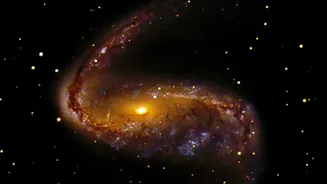
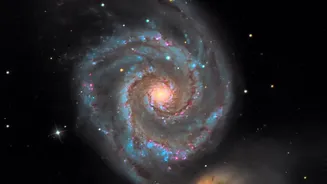
Beyond finding new galaxies, the latest images are providing an unprecedented look at the engines that drive them. By observing thousands of star clusters in nearby galaxies, JWST is creating a detailed map of stellar birthplaces. These images show how massive, young stars carve out cavities in the surrounding gas with powerful stellar winds, influencing how the next generation of stars will form. At the other end of the lifecycle, the telescope is studying “quenched” galaxies—systems that have abruptly stopped forming stars. New research on galaxies observed as they were 9 billion years ago is helping scientists pinpoint the violent events, such as galactic mergers or explosive feedback from black holes, that can suddenly shut down a galaxy’s star-making factory. By seeing both the cradles and the graves of stars in such detail, we are getting a more complete picture of how galaxies live and die.
The Black Hole Connection
At the heart of most large galaxies, including our own, lurks a supermassive black hole. For a long time, the exact relationship between these monsters and their host galaxies has been a major question. New observations are finally providing some answers. The detailed images of Centaurus A, for instance, not only show the aftermath of a galactic merger but also reveal the influence of its active black hole. As the black hole feeds on surrounding gas and dust, it launches powerful jets of energy. Using JWST’s spectroscopic instruments, astronomers can measure gas flowing away from the black hole, showing how it can blast away material needed for star formation. At the same time, the pressure from these outflows can also compress gas clouds elsewhere, triggering new bursts of star birth. This complex push-and-pull shows that black holes are not just passive anchors but active sculptors of the galaxies they inhabit.