

Cosmic Nurseries Under the Microscope
Imagine a vast, spinning platter of gas and dust circling a newborn star. This is a protoplanetary disk, the raw material from which entire solar systems are built. For decades, scientists have theorized that within these disks, tiny dust grains begin
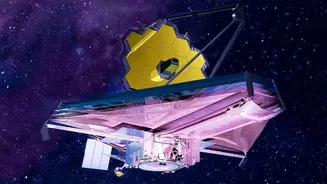
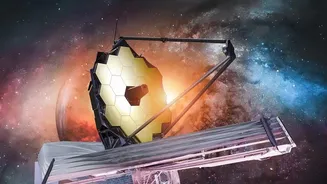
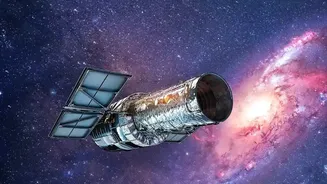
to stick together, like cosmic dust bunnies. These clumps grow into larger bodies called planetesimals, which continue to collide and merge over millions of years, eventually forming the planets, moons, and asteroids we see in our own solar system and beyond. However, actually witnessing this process has been incredibly difficult. These stellar nurseries are dense and opaque, shrouding the secrets of planetary birth in thick clouds of dust that are impenetrable to telescopes that see in visible light, like the Hubble. This is where the James Webb Space Telescope (JWST) changes the game entirely.
The Superpower of Infrared Vision
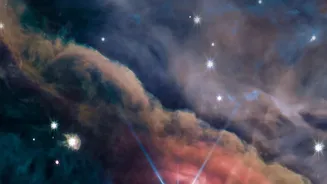
The JWST’s primary advantage is its ability to see the universe in infrared light. Unlike visible light, which gets scattered and absorbed by cosmic dust, infrared light can pass straight through it. This allows astronomers to peer into the very heart of these dense, dusty disks and observe the planet-formation process in action for the first time. It is the equivalent of having X-ray vision for the cosmos. The telescope's Mid-Infrared Instrument (MIRI) is especially crucial, as it can detect the faint heat glow from the dust itself, revealing its structure and composition. By analyzing specific infrared wavelengths, scientists can identify the signatures of different molecules and elements, such as molecular hydrogen, water, and even neon, providing vital clues about the environment where planets are taking shape.
What the New Scans Actually Show
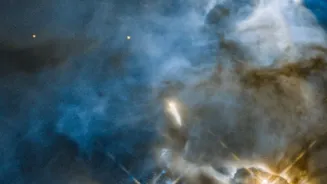
Recent studies using JWST data have delivered stunning revelations. One major survey of 72 young, Sun-like stars found that the gas needed to form giant planets like Jupiter is cleared out in a dynamic race against time. The telescope's observations show that in the earliest stages, powerful jets and winds driven by the star's magnetic field push material away. As the system ages, a process called photoevaporation takes over, where the star's own high-energy radiation heats up the gas until it escapes. In another groundbreaking observation of a young star system known as T Cha, Webb detected winds of gas, including neon and argon, streaming away from the disk. This helps scientists understand exactly when and how the primordial gas that builds gas giants disappears, which dictates how much time these massive planets have to form. These detailed snapshots are transforming theoretical models into direct observations.
Rewriting the Story of Our Origins
These findings do more than just show us what’s happening in distant star systems; they provide a crucial reference point for understanding our own origins. By studying the variety of ways planets form elsewhere, we can piece together the specific sequence of events that led to the creation of Earth, Mars, Jupiter, and the rest of our cosmic neighbourhood. For example, recent JWST research has challenged existing models by showing that planet-forming disks in the early universe, which had fewer heavy elements, may have lasted longer than previously thought. This suggests that planets had more time to grow back then, helping to solve long-standing puzzles about massive planets found around ancient stars. Each new image and data set from Webb helps refine our understanding of the history and chemical makeup of our own solar system.