

The Monsoon Conundrum
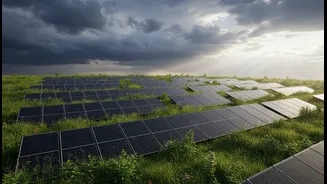
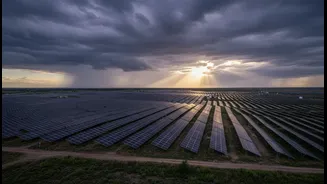
India has rapidly become a global leader in solar power, with vast solar farms and rooftop panels dotting the landscape. This reliance on the sun, however, has a critical vulnerability: the annual monsoon season. From roughly June to October, heavy cloud
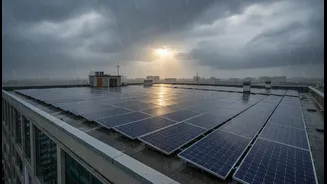
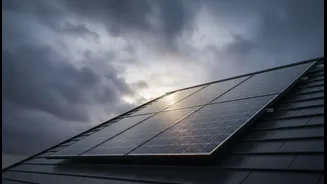
cover can drastically reduce the amount of sunlight reaching photovoltaic (PV) cells. Studies have shown that solar irradiance can decrease by 15% or more during this period, leading to a significant drop in energy production across the country. For a nation increasingly dependent on solar to power its economy, this seasonal dip is more than an inconvenience; it is a major challenge to grid stability and energy security. This forces a partial reliance on other energy sources, undermining the goal of round-the-clock renewable power. While rain does help by washing away dust that accumulates on panels, the overall loss of output is a serious concern.
A Hybrid Solution Emerges
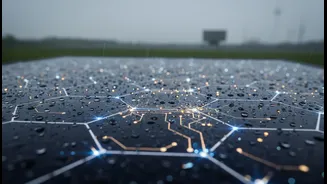
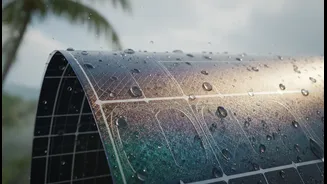
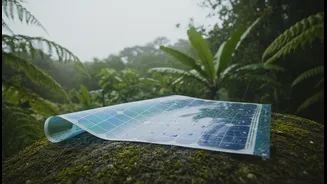
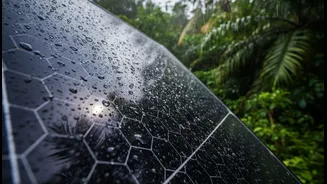
To solve this uniquely Indian problem, scientists are looking beyond traditional solar technology. The big idea is to create a hybrid device that can harvest energy not just from sunlight, but from the kinetic energy of falling raindrops. Imagine a single panel that continues to generate electricity, day or night, as long as it is either sunny or raining. This isn't science fiction; it's the frontier of materials science. Researchers are developing integrated panels that combine a standard photovoltaic layer for capturing sunlight with a special layer that generates power from the impact of raindrops. This all-weather approach could transform solar panels from fair-weather friends into a resilient, year-round power source.
The Science of Rain Power
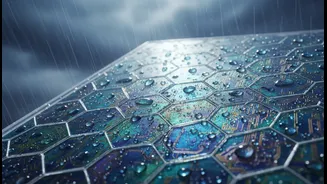
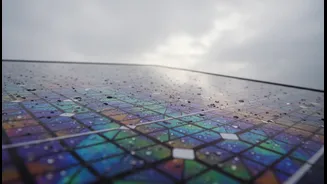
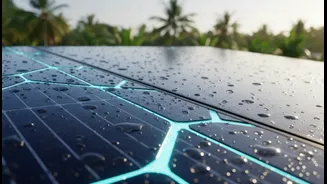
The magic behind generating electricity from rain lies in a phenomenon called the triboelectric effect. This is the same effect that creates static electricity when you rub a balloon on your hair. Scientists are creating transparent films to place over solar cells. These films, often made of materials like polydimethylsiloxane (PDMS), act as a Triboelectric Nanogenerator, or TENG. When a raindrop, which is naturally slightly positively charged, strikes the negatively charged surface of the film, an electrical charge is created and captured. The impact creates a tiny but measurable voltage. While a single drop doesn't produce much power, a downpour with millions of drops hitting a large array of panels can generate a useful amount of electricity, especially for powering small sensors or contributing to the grid during low-sunlight conditions.
Perovskites and Protective Films
Much of the cutting-edge research in this field involves a new class of materials called perovskites. Perovskite solar cells are highly efficient at converting sunlight to energy and are cheaper to produce than traditional silicon cells. Their main drawback has been a vulnerability to moisture, which causes them to degrade. However, scientists have turned this weakness into a strength. By developing ultrathin, waterproof protective coatings for perovskite cells, they not only solve the durability issue but also use that same coating as the triboelectric layer to harvest rain energy. This dual-purpose film protects the sensitive solar cell while simultaneously enabling it to generate power from rainfall, making the entire unit more robust and versatile. This innovation could make solar panels far more resilient in India's humid, rainy climates.
The Road Ahead for India
While this technology is incredibly promising, it is still largely in the research and development phase. Scientists at institutions globally, with some work happening in Indian institutes like IIT Delhi on TENGs, are racing to improve the efficiency and scalability of these hybrid panels. The main challenges are to increase the power output from the raindrop harvesters and to develop manufacturing processes that are cost-effective for mass production. However, the potential payoff is enormous. For India, a commercially viable all-weather solar panel would be a game-changer. It would smooth out the seasonal fluctuations in power generation, enhance energy independence, and bring the country one step closer to its goal of a sustainable energy future, come rain or shine.