




The Sun’s Unpredictable Temper
Space is not as empty as it seems. Our sun is an active star that constantly sends out a stream of charged particles known as the solar wind. Occasionally, it unleashes much more powerful events: solar flares, which are massive bursts of energy, and coronal
mass ejections (CMEs), which are gigantic explosions of plasma and magnetic fields from the Sun's outer atmosphere, the corona. These phenomena are the primary drivers of what scientists call space weather. When these storms of radiation and energetic particles are directed towards Earth, they can have significant consequences for our technology-dependent society. While they also create beautiful auroras, their impact on our infrastructure is far less picturesque.
How Solar Storms Scramble Our Signals
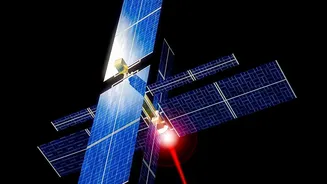
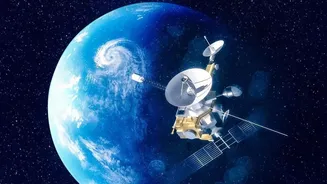
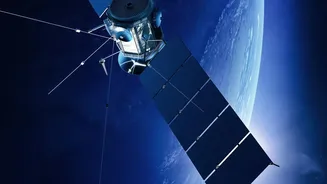
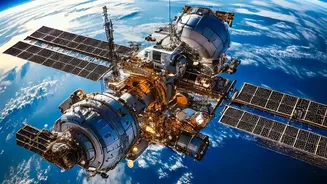
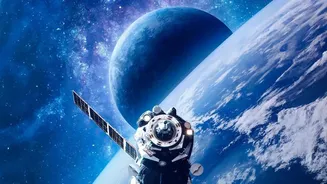
Satellites are particularly vulnerable to space weather. The high-energy particles from a solar storm can damage sensitive electronics and cause malfunctions, sometimes leading to permanent failure. Beyond direct damage, space weather wreaks havoc on the very signals that satellites transmit. As these storms hit Earth, they disturb the ionosphere, an upper layer of our atmosphere. This disturbance can bend, distort, or completely block the radio waves used for communication and navigation. The result can be dropped calls on satellite phones, inaccurate GPS locations, and disruptions to satellite television and internet services. During severe events, the upper atmosphere can heat up and expand, increasing atmospheric drag on satellites in low-Earth orbit and potentially causing them to fall out of their orbits prematurely.
A New Dawn for Cosmic Forecasting
Just as terrestrial weather forecasts help us prepare for rain or storms, space weather forecasting aims to provide advance warning of solar events. Until recently, these warnings often came only hours before impact. However, a new generation of satellites and analytical tools is changing the game. Missions strategically placed between the Sun and Earth are providing an unprecedented, continuous view of our star. Furthermore, scientists are developing sophisticated new models, some using artificial intelligence, to analyse vast amounts of solar data. These AI-driven systems can identify patterns that precede solar flares or CMEs, with some new tools aiming to extend forecast warnings from hours to potentially weeks in advance. This marks a critical shift from simply reacting to space weather to proactively anticipating it.
The Future of Reliable Connections
The benefits of more accurate and timely space weather forecasts are immense. With a reliable early warning, satellite operators can take protective measures to safeguard their multi-million dollar assets. For example, they can command a satellite to enter a 'safe mode,' shutting down non-essential and sensitive components until the storm passes. This simple action can prevent catastrophic damage and extend the operational life of the satellite. For communication services, predictive models allow network operators to anticipate disruptions, reroute data traffic, and manage customer expectations, leading to a more resilient and reliable global communication network. Ultimately, it translates to more dependable GPS navigation for transport, stabler connections for remote businesses, and uninterrupted service for millions of users.
The Indian Vantage Point
India has firmly established itself as a key player in this global effort with its Aditya-L1 mission. Positioned at a special vantage point 1.5 million kilometres from Earth, ISRO's solar observatory provides an uninterrupted view of the Sun. Its instruments are designed to study the very phenomena that drive space weather, such as the dynamics of the solar corona and the initiation of CMEs. Data from Aditya-L1 is already yielding breakthrough insights into how solar storms interact with Earth's magnetic field. For a nation rapidly expanding its digital infrastructure and reliant on its own satellite systems like the NavIC navigation constellation, this homegrown capability is not just a matter of scientific pride—it's an essential tool for securing its economic and strategic future in an increasingly connected world.