
For decades, we've understood the universe to be about 13.8 billion years old. But what if it were nearly twice that age? A new theory challenges our cosmic timeline, offering a solution to some of astronomy's most stubborn puzzles.
Our Universe's Standard Story
The prevailing scientific
consensus is that our universe began with the Big Bang. This event marked the start of space, time, and all matter. The dominant theory describing what happened next is the Lambda-Cold Dark Matter (ΛCDM) model. It suggests the universe is composed of ordinary matter (like stars and people), 'cold dark matter' (an invisible substance providing extra gravity), and 'dark energy' (a force causing the universe's expansion to accelerate). By measuring the rate of this expansion and tracing it backward, physicists have confidently estimated the universe's age at 13.8 billion years. This figure has been a cornerstone of cosmology for years, shaping our understanding of how everything from galaxies to planets came to be.
A Cosmic Puzzle Emerges
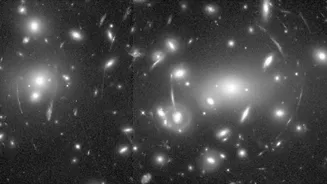
The ΛCDM model has been remarkably successful, but recent discoveries have presented a major challenge. Data from the James Webb Space Telescope (JWST) has revealed galaxies in the very early universe that are surprisingly mature. These galaxies, seen at a time when the universe was supposedly only a few hundred million years old, appear far too massive and developed. Under the standard 13.8-billion-year timeline, there simply wasn't enough time for them to grow so large, leading to the 'impossible early galaxy problem'. This cosmic conundrum has sent some scientists searching for alternative explanations, questioning if a fundamental piece of our cosmic story might be wrong.
A New Cosmic Recipe
Enter Rajendra Gupta, a physicist from the University of Ottawa. He proposes a new model that could solve this puzzle by doubling the age of the universe to 26.7 billion years. His theory, known as the CCC+TL model, is a hybrid of two ideas. The first part, 'Covarying Coupling Constants' (CCC), suggests that the fundamental forces of nature, which we assume are constant, might actually change over cosmic time. The second part resurrects an old idea called 'Tired Light' (TL), first proposed by Fritz Zwicky in 1929. This theory posits that light loses energy as it travels across vast cosmic distances. In Gupta's model, the redshift we observe from distant galaxies isn't just from the expansion of space (as the standard model holds), but a combination of expansion and this 'tiring' of light.
Rewriting the Beginning
The implications of this hybrid model are profound. By reinterpreting redshift, the CCC+TL model extends the timeline for cosmic events. Those 'impossible' early galaxies observed by the JWST would no longer be a problem. In a 26.7-billion-year-old universe, the 'cosmic dawn'—when the first stars and galaxies formed—would have occurred much earlier, providing billions of extra years for these massive structures to evolve. Furthermore, Gupta suggests this new framework could explain cosmic phenomena without the need for dark matter or dark energy, two of the most mysterious elements of the standard model. The effects we attribute to these invisible forces could instead be the result of the physical constants changing over time.
Science in Action
It is crucial to understand that the CCC+TL model is a proposal, not a proven fact. The standard ΛCDM model remains the dominant and most widely accepted explanation for the universe's evolution because it successfully accounts for a vast range of astronomical observations. Overturning such a well-established theory requires an extraordinary amount of evidence. Gupta and his collaborators have tested their model against several observations, such as galaxy rotation and the abundance of early elements, and reported that it holds up. However, the scientific community remains cautious. The model still needs to be tested against other key cosmic benchmarks, like the precise details of the Cosmic Microwave Background—the faint afterglow of the Big Bang. This process of proposing, testing, and debating new ideas is the very engine of scientific progress.