





The Cracks in Our Crystal Ball
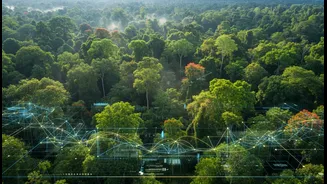
For decades, scientists have used complex computer simulations, known as Earth System Models, to forecast the fate of our planet's forests. These models are crucial for climate policy, helping us understand how ecosystems will respond to rising temperatures
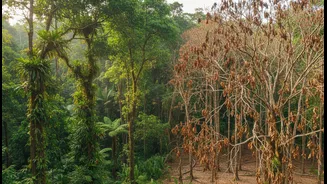
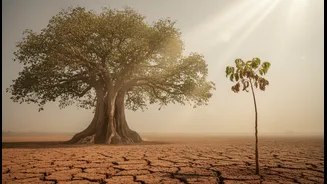
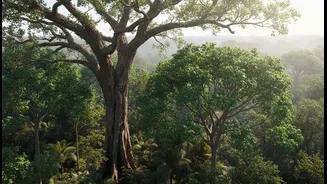
and changing rainfall. Yet, there’s a growing problem: when it comes to tropical forests, the models are struggling. Recent studies have shown that the models often fail to capture the real-world dynamics of these vital ecosystems, particularly how they respond to drought. Field observations suggest the carbon-absorbing capacity of some tropical forests has been declining for decades, but the models don't reflect this reality, sometimes even predicting the opposite. The reason is that many models treat vast, diverse forests as a single, uniform entity, failing to account for the incredible variety of survival strategies among different tree species. This simplification creates a major blind spot in our ability to predict when a forest might reach a critical tipping point.
A Tree's Internal Plumbing
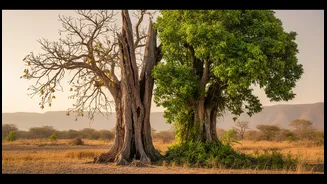
The key to a better forecast lies in understanding a tree's internal plumbing system. This system is centered around the xylem, a network of tiny tubes that transport water from the roots up to the leaves. The efficiency and resilience of this plumbing are determined by a tree's 'hydraulic traits'. Think of it like the water pipes in a building. Some pipes are wide, allowing for high flow, while others are narrow and more resistant to pressure changes. Similarly, some trees have xylem that is highly efficient at moving water but vulnerable to collapse during a drought. When water is scarce, the tension inside the xylem increases, which can cause air bubbles (embolisms) to form, blocking the flow of water and potentially killing the tree. Other trees have safer, more robust xylem that is less efficient but can withstand intense drought conditions. These hydraulic traits, which vary enormously from one species to another, dictate which trees will survive and which will perish in a hotter, drier world.
Putting Forests to the Test
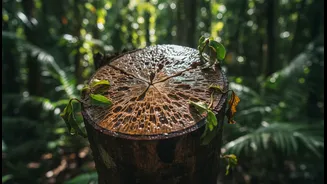
To understand these traits, scientists can't just rely on observation; they need to experiment. Across the globe, researchers are conducting large-scale drought experiments in tropical forests. In places like Panama and the Amazon, scientists build massive panels over sections of the forest to block a percentage of rainfall, simulating a long-term drought. Inside these experimental plots, they meticulously track how different species respond. They measure everything from sap flow and leaf water potential to root growth and, ultimately, tree mortality. These experiments provide invaluable, real-world data on how specific hydraulic traits correlate with survival. For example, research has shown that trees with a lower 'hydraulic safety margin'—meaning their normal operating water pressure is dangerously close to the pressure that causes xylem failure—are most at risk of dying during a drought.
A Clearer View of the Future
This detailed, plant-level information is a game-changer for forecasting. By feeding hydraulic trait data into a new generation of vegetation models, scientists can move beyond simplistic, one-size-fits-all predictions. Instead of treating a forest as a monolithic green carpet, these updated models can simulate the competition between individual species with different strengths and weaknesses. They can predict which types of trees are likely to die off and which will thrive, leading to a shift in the forest's overall composition. This more nuanced approach allows for a much more realistic forecast of how a forest's ability to store carbon, produce rainfall, and support biodiversity will change over time. It helps us see not just if a forest will suffer, but how it will transform, providing a critical tool for anticipating and mitigating the effects of climate change.
Why This Matters for India and the World
The health of tropical forests in the Amazon or the Congo might seem distant, but their fate is directly linked to our own. These ecosystems play an outsized role in regulating global climate patterns, and their decline has worldwide consequences. For India, which has its own precious tropical forests like the Western Ghats, understanding drought resilience is a matter of national importance. These forests are hotspots of biodiversity and crucial for the water security of millions. The scientific principles being developed in these global experiments are universally applicable. By embracing a trait-based approach, we can better manage and protect our own ecosystems. It allows for more targeted conservation efforts, identifying the most vulnerable species and areas before it’s too late. In a world facing increasing climate uncertainty, this deeper scientific understanding is one of our most powerful tools for safeguarding the planet’s green lungs.