

The Real Problem with Sitting All Day
When you sit for extended periods, your hips are held in a flexed position. This causes the group of muscles at the front of your hips, known as the hip flexors, to become adaptively short and tight. Over time, this tightness can pull your pelvis out
of its optimal alignment, contributing to poor posture and even lower back pain. Meanwhile, the opposing muscles, particularly your glutes, can become weak from underuse. This creates a muscular imbalance that restricts your range of motion and makes simple movements like standing up from your chair feel stiff and uncomfortable. The goal is to counteract this by gently lengthening the hip flexors and activating the glutes.
Exercise 1: Kneeling Hip Flexor Stretch
This classic stretch directly targets the muscles that become shortened from sitting. Start by kneeling on your right knee, perhaps with a cushion underneath for comfort. Place your left foot on the floor in front of you with your knee bent at a 90-degree angle. Keeping your back straight and your core engaged, gently push your hips forward until you feel a comfortable stretch in the front of your right hip and thigh. Avoid arching your lower back. Hold this position for 20-30 seconds, breathing deeply. Switch sides and repeat for a total of two to three times on each leg.
Exercise 2: Seated Figure-Four Stretch
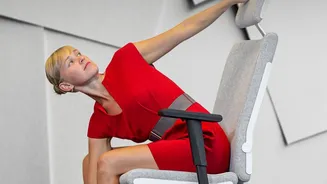
This stretch targets the outer hip and glute muscles, which can also become tight and contribute to discomfort. Sit tall on the edge of a sturdy chair with your feet flat on the floor. Cross your right ankle over your left knee, creating a 'figure four' shape. Gently press down on your right knee to deepen the stretch in your right glute and hip. To increase the intensity, you can hinge forward at your hips while keeping your spine straight. Hold for 20-30 seconds, feeling the release in your hip. Release and repeat on the other side. This is a great exercise you can even do during a short break at the office.
Exercise 3: Glute Bridges
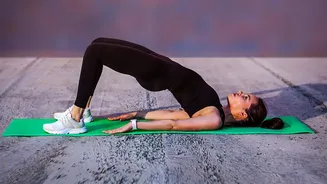
Counteracting tight hip flexors also involves strengthening the glutes. Lie on your back with your knees bent, feet flat on the floor about hip-width apart, and your arms by your sides. Engage your core and glutes, then lift your hips off the floor until your body forms a straight line from your shoulders to your knees. Squeeze your glutes at the top of the movement and hold for a couple of seconds before slowly lowering your hips back down. Aim for 10-15 repetitions. This movement helps 'wake up' the gluteal muscles that are often inactive during long periods of sitting.
Exercise 4: Cat-Cow Stretch
While not exclusively a hip stretch, the cat-cow movement improves mobility in the spine and promotes gentle movement through the pelvis, which is closely linked to hip health. Start on your hands and knees with your wrists under your shoulders and your knees under your hips. As you inhale, drop your belly, lift your chest, and look forward (Cow Pose). As you exhale, round your spine toward the ceiling, tucking your chin to your chest (Cat Pose). Flow between these two positions for 8-10 breaths, allowing the movement to gently mobilize your hips and lower back.
The Power of Gentle Consistency
The key to undoing office strain isn't one intense workout session per week. Instead, it’s about incorporating small, consistent movements into your daily routine. These gentle exercises are effective because they regularly signal to your muscles that they need to lengthen and move through their full range, counteracting the hours spent in a static seated position. Taking just five to ten minutes each day to perform these stretches can lead to significant improvements in flexibility, a reduction in discomfort, better posture, and an overall feeling of greater mobility in your daily life.