



Sparking Interest in School
The journey into space often begins in the classroom. A strong foundation in Physics, Chemistry, and Mathematics (PCM) is crucial. Students should actively participate in school-level science exhibitions, Olympiads, and coding competitions. These activities
build foundational problem-solving skills and a scientific temperament. Beyond the curriculum, joining an astronomy club or a science club can provide practical exposure. Many online resources and documentaries about space exploration can also fuel curiosity and provide a deeper understanding of the cosmos.
ISRO's YUVIKA Programme
To 'catch them young', the Indian Space Research Organisation (ISRO) runs the YUva VIgyani KAryakram (YUVIKA) or Young Scientist Programme. This is a two-week residential program designed to give school students a foundational understanding of space science and technology. It is primarily aimed at students who are in Class 9. Selection is based on merit, including Class 8 marks, performance in an online quiz, and participation in extracurricular activities like science fairs and Olympiads. ISRO fully sponsors the program, covering travel, lodging, and course materials for the selected students.
The Gateway After Class 12
After completing Class 12 with a PCM background, the pathways to a space career become more defined. The most direct route into ISRO is through the Indian Institute of Space Science and Technology (IIST) in Thiruvananthapuram. Admission to its undergraduate programs, such as B.Tech in Aerospace Engineering and Electronics and Communication Engineering (Avionics), is highly competitive and based on performance in the Joint Entrance Examination (JEE) Advanced. Graduates from IIST with a strong academic record may be considered for absorption into Scientist/Engineer roles at ISRO, subject to vacancies and specific criteria.
Pursuing Relevant Degrees
Besides IIST, a B.Tech or B.E. degree in fields like Aerospace, Aeronautical, Mechanical, Electronics, or Computer Science from a reputed institution is a strong pathway. Premier institutes like the Indian Institutes of Technology (IITs) in Bombay, Madras, and Kanpur are renowned for their aerospace engineering programs. For those interested in research roles, a B.Sc followed by an M.Sc in Physics, Astronomy, or Mathematics is a viable option. To join ISRO as a Scientist/Engineer, a minimum aggregate of 65% or a CGPA of 6.84 is generally required in the qualifying degree.
Gaining Practical Experience
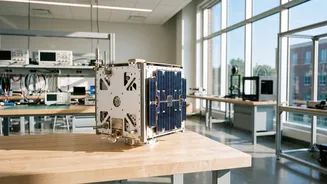
Practical experience is invaluable. ISRO offers internship schemes and student project trainee programs for students pursuing degrees in science and technology. These opportunities, available at various ISRO centres like VSSC and URSC, allow students to work on real projects, although they are typically unpaid. Additionally, the government is promoting student participation through initiatives like the Space Technology Incubation Centres (STICs) and student satellite programs, which provide mentorship and funding. Participating in competitions that involve designing model rockets and CanSats (can-sized satellites) is another excellent way to gain hands-on experience.
The New Frontier: Private Space Sector
India's space sector is no longer limited to government agencies. The rise of private companies like Dhruva Space, Skyroot Aerospace, and Agnikul Cosmos has opened up a new and exciting frontier for space careers. These startups are involved in everything from building satellites to developing launch vehicles. They actively look for young talent and often offer internships in specialized areas like propulsion, design, and embedded systems. As the government's policies encourage more private participation, the opportunities in this commercial space ecosystem are set to grow exponentially.