





A New Cosmic Masterpiece
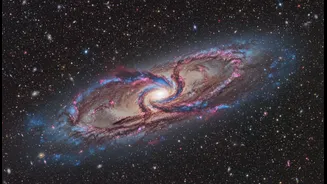
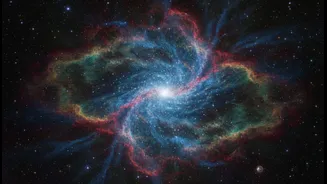
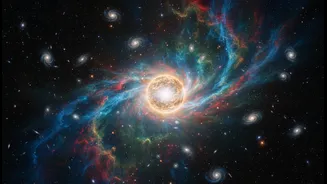
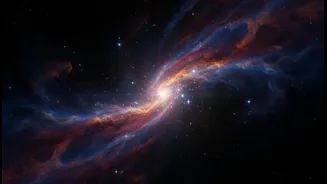
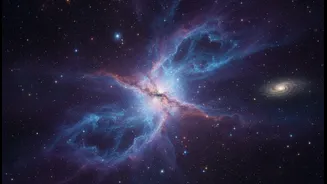
To mark the fourth anniversary of its first public images, NASA has released an unprecedented view of Centaurus A, a galaxy located about 11 million light-years from Earth. Captured by Webb's powerful infrared instruments, the image cuts through cosmic
dust to reveal the galaxy's active centre with stunning clarity. Centaurus A is of particular interest to scientists because it is the result of a massive galactic collision that occurred some two billion years ago. This cosmic crash has left it with an unusual structure, an abundance of material for new star formation, and a supermassive black hole at its core that is actively feeding on surrounding matter. The new images allow astronomers to study the galaxy star by star, essentially performing galactic archaeology to piece together its violent history and understand how such collisions shape the universe.
The Indian Minds Behind the Mission
While the telescope orbits a million miles from Earth, its success is grounded in the tireless work of thousands of people, including several scientists of Indian origin who have played pivotal roles. Their stories are a crucial part of the Webb narrative. Among them is Dr. Hashima Hasan, a Deputy Program Scientist for the JWST. Born in Lucknow, her fascination with space began when her grandmother showed her the Sputnik satellite in the sky as a child. This early inspiration led her through Aligarh Muslim University, the Tata Institute of Fundamental Research (TIFR) in Mumbai, and eventually to a doctorate from Oxford University and a key position at NASA. In her role, she helps ensure the telescope's science program meets its ambitious goals.
Engineering and Programming the Cosmos
The telescope’s hardware and software also have a deep Indian connection. Kalyani Sukhatme, who grew up in Mumbai and is an IIT Bombay alumna, served as the project manager for the Mid-Infrared Instrument, or MIRI. MIRI is one of Webb's four main instruments and is responsible for producing some of its most breathtaking mid-infrared images, including the new view of Centaurus A. Her work was critical to the development and operation of this key piece of technology. Then there is Dr. Kartik Sheth, an astrophysicist who has served as a program scientist for JWST. His work has focused on galaxy formation and evolution, the very science Webb is now revolutionizing. Educated in India before moving to the US, his portfolio at NASA has included overseeing missions like Webb and ensuring their scientific output reaches its maximum potential.
A Legacy of Inspiration
The involvement of these scientists is more than just a footnote; it represents a legacy of Indian contribution to global scientific endeavours. Dr. Hasan, for example, has spoken about being one of the few women in her field when she started and now serves as a role model for a new generation. The work of scientists at the Indian Institute of Astrophysics in Bengaluru, who have developed models using JWST data to hunt for elusive 'exomoons', further demonstrates how the telescope is a tool for the global scientific community. This synergy between Indian talent and international projects highlights a crucial aspect of modern science: it is a collaborative enterprise that transcends borders. The stunning images from Webb belong to everyone, and the story of how they are made includes a proud chapter written by Indian minds.