





A Galaxy of Cosmic Chaos
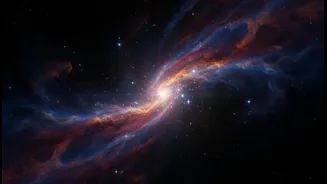
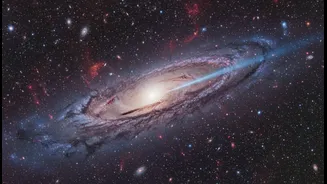
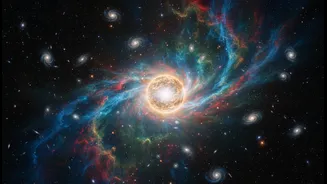
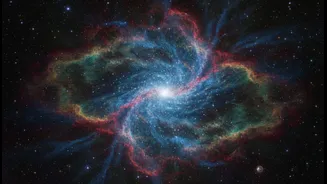
Located about 11 to 13 million light-years away, Centaurus A is not a quiet cosmic neighbour. It is the result of a colossal collision between a large elliptical galaxy and a smaller spiral galaxy, an event that occurred roughly two billion years ago.
The James Webb Space Telescope's new images, released to mark its fourth year of science operations, cut through the galaxy's thick, obscuring dust to reveal its chaotic heart in unprecedented detail. At its center, a supermassive black hole, with a mass of about 55 million Suns, is actively feeding on surrounding gas and dust, launching powerful jets of energy into space. Webb's infrared vision exposes intricate dust lanes, a warped parallelogram-shaped band of gas, and countless individual stars, allowing for a kind of 'galactic archaeology' that helps scientists piece together the galaxy's violent history.
Why This Celestial Portrait Matters
This new view is scientifically invaluable. Previous telescopes like Hubble were blocked by the dense dust, while the retired Spitzer telescope could see in infrared but couldn't resolve individual stars. Webb’s clarity now allows astronomers to study Centaurus A star by star, observing stellar nurseries where new suns are born and aging stars shed their material back into the cosmos. Because it's the closest active galaxy to Earth, studying it helps us understand fundamental processes of galaxy evolution, the lifecycle of stars, and how supermassive black holes influence their environments. The mysterious 'S' shaped features and glowing filaments captured by Webb pose new questions that will drive research for years, offering a perfect natural laboratory for cosmic events that shape the universe.
From Distant Galaxy to a Career in India
An image of a galaxy millions of light-years away might feel distant, but the science behind it has created incredible opportunities right here in India. The nation's space ambitions, spearheaded by the Indian Space Research Organisation (ISRO), require a new generation of brilliant minds. The skills needed to capture and interpret data from telescopes like Webb are the same skills driving India's growing space-tech sector. This isn't just about becoming an astronomer. It's about data analysis, engineering, physics, and even science communication. The awe inspired by Centaurus A can be the starting point for a tangible, exciting career in a field where India is a major global player. The journey from staring at the stars to helping India reach them is shorter than you might think.
Your Roadmap to the Stars: First Steps
For students dreaming of a career in this field, the path in India is well-established. While dedicated undergraduate degrees in astronomy are rare, a Bachelor's in Physics (BSc) or Engineering (B.Tech) is the standard and highly effective starting point. After graduation, you can pursue a Master's (MSc or M.Tech) and eventually a Ph.D. in specialised fields like astrophysics, astronomy, or space science. Key institutions to aim for include the Indian Institute of Astrophysics (IIA) in Bangalore, the Inter-University Centre for Astronomy and Astrophysics (IUCAA) in Pune, and the Tata Institute of Fundamental Research (TIFR) in Mumbai. For those interested in a more direct route into the national space programme, the Indian Institute of Space Science and Technology (IIST) in Thiruvananthapuram, established by ISRO, offers specialised undergraduate and postgraduate programmes designed to train future space scientists and engineers.
Beyond the Telescope: A Universe of Roles
A passion for space doesn't have to lead only to a research-based Ph.D. The field is vast. Technologists are needed to build and maintain the complex instruments on telescopes and satellites. Data scientists and analysts are crucial for making sense of the enormous datasets generated by modern astronomy. Engineers of all types—mechanical, electronics, computer science—are the backbone of organisations like ISRO, designing everything from rocket engines to satellite communication systems. There are also growing careers in science communication, working for planetariums, museums, or media to share these incredible discoveries with the public. Whether your skills lie in complex math, hands-on engineering, or compelling storytelling, there is a place for you in India's journey to the stars.