






The Junkyard Above Our Heads
It’s an invisible environmental crisis unfolding hundreds of kilometres above us. For decades, every rocket launch and satellite deployment has left something behind. Today, low Earth orbit (LEO) is cluttered with more than 29,000 tracked objects larger
than a softball, and an estimated 130 million smaller, untraceable fragments. This isn't just floating junk; it’s a swarm of projectiles travelling at speeds up to 28,000 kilometres per hour. At that velocity, even a paint chip can cripple a multi-million dollar satellite. The bigger concern is a cascade event known as the Kessler Syndrome, where one collision creates a cloud of new debris, which in turn causes more collisions, potentially rendering entire orbits unusable for generations. This threatens everything from GPS navigation and weather forecasting to global communications—the pillars of our modern digital economy.
A Propellant-Free Solution
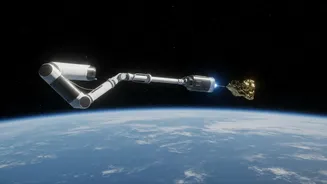
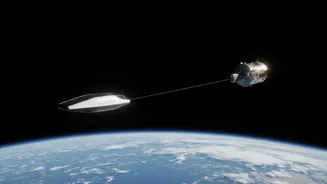
Removing this debris is incredibly complex. Previous ideas have involved nets, harpoons, and robotic arms, all of which require complex rendezvous manoeuvres and, crucially, fuel. Every kilogram of fuel launched into space is expensive, limiting the scope of any cleanup mission. This is why researchers are so focused on a more elegant solution: the electrodynamic tether. While the headline refers to them as 'magnetic tethers', the term more accurately describes how they function. They don't attract debris like a simple magnet. Instead, these are long, conductive wires, often made of a thin aluminium tape, that are deployed from a satellite. They use the Earth's own magnetic field to generate force without burning a single drop of propellant, offering a potentially revolutionary, low-cost way to deorbit space junk.
How Electrodynamic Tethers Work
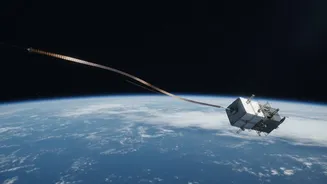
The science behind it is a clever application of fundamental physics. Earth is not just a rock; it's a giant magnet surrounded by a magnetic field and a layer of charged particles called the ionosphere. When a long conductive tether is unspooled from a satellite and moves through this environment, it generates an electrical current along its length. This current interacts with the planet’s magnetic field, creating a force known as the Lorentz force. This force acts as a brake, producing a persistent, gentle drag on the satellite. Over weeks or months, this drag is enough to slow the object down, causing its orbit to decay until it falls into the upper atmosphere and safely burns up. Because it requires no onboard fuel, a small, lightweight tether system can be attached to satellites before launch, acting as a built-in disposal mechanism at the end of their life.
The Race to Test the Tethers
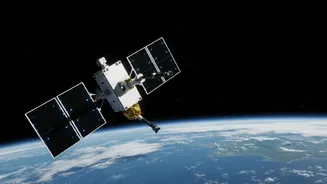
This technology isn't just theoretical; it's actively being developed and tested by a new generation of space companies. European startup PERSEI Space, with backing from the European Space Agency (ESA), is a key player. Their ECO-Tethers project, a collaboration with industry giants like Astroscale and Thales Alenia Space, is maturing the technology with a major demonstration mission planned for 2026. That test aims to use a tether around 430 meters long to deorbit a satellite. Meanwhile, in the United States, a company called Tethers Unlimited (now part of Arka) pioneered a product called the Terminator Tape, a compact tether designed for small satellites to ensure they can deorbit responsibly. These efforts show a clear shift in the industry from simply mitigating the creation of new debris to actively developing the tools to remove what's already there.
Hurdles on the Path to a Cleaner Orbit
Despite its promise, the road to a clean orbit is filled with challenges. For one, electrodynamic tethers are primarily a preventative measure or a solution for cooperative targets. They are ideal for new satellites designed to deorbit themselves. Using them to clean up existing, non-functional debris is much harder. It would require a 'space tug' to first capture a tumbling, uncontrolled piece of junk—a highly complex robotic task—and then attach a tether. Furthermore, there are significant legal and political questions. Under international law, a satellite remains the property of the nation that launched it, even if it's just a piece of junk. Removing it without permission is technically illegal, creating a diplomatic hurdle that has yet to be solved. Finally, there's the economic question: who pays? While the market for debris removal is growing, estimated to be worth over a billion dollars, the cost of a single cleanup mission remains high.